
Shall I Project a World?
On Thomas Pynchon's 'The Crying of Lot 49'

Everything flows out of somewhere. This theme is made literal by the most blatant artistic reference in Thomas Pynchon’s The Crying of Lot 49, Remedios Varo’s painting, Bordando el Manto Terrestre (Embroidering the Mantle). Serving as the central panel in a triptych, Mantle features six girls in the top room of a tower busily weaving while under the supervision of a pair of imposing, masked individuals, stand-ins for what we here at Gnostic Pulp might call archons, but whom Pynchon is happy to refer to simply as They.
The product of their weaving flows out of slit windows in the tower in a great flood that covers the earth with a layer we might name the psychostrata.
“In the central painting of a triptych, titled ‘Bordando el Manto Terrestre,’ were a number of frail girls with heart-shaped faces, huge eyes, spun-gold hair, prisoners in the top room of a circular tower, embroidering a kind of tapestry which spilled out the slit windows and into a void, seeking hopelessly to fill the void: for all the other buildings and creatures, all the waves, ships and forests of the earth were contained in this tapestry, and the tapestry was the world.”
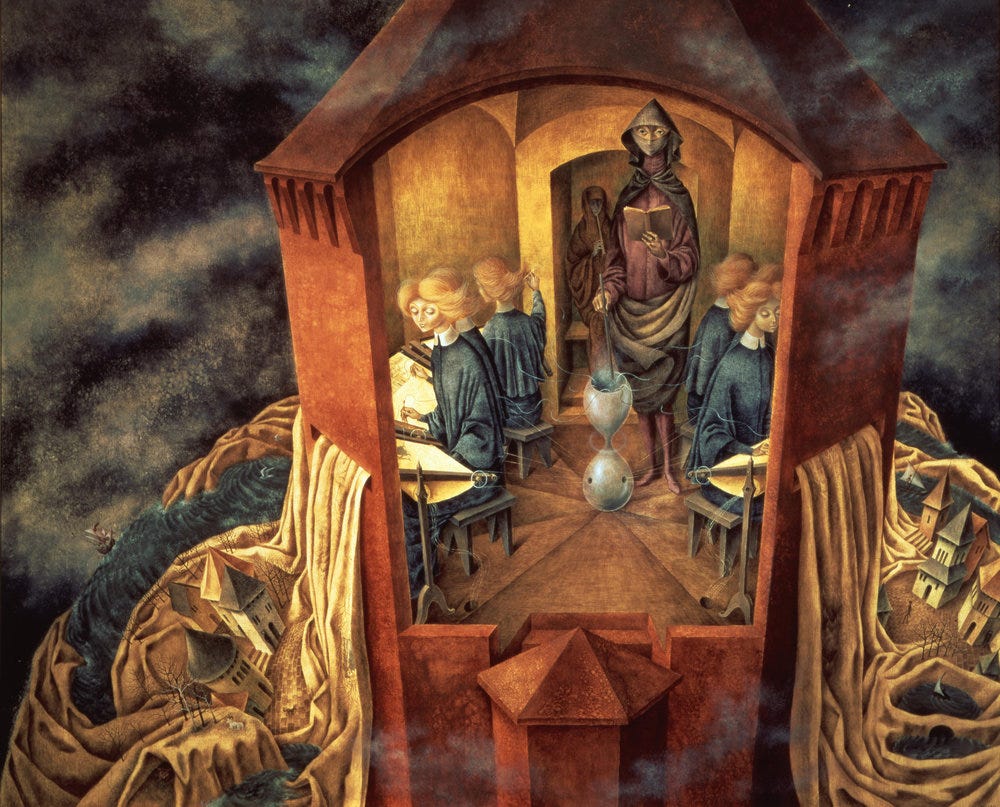
The World—there you have it, folks. I needed some sort of magical eye to break open this book, and Pynchon slipped it in right under our noses, like a muted trumpet painted upon a bathroom stall. The World. Just like that, I knew exactly the text to consult. I broke out my copy of the anonymously penned Meditations on the Tarot: A Journey into Christian Hermeticism and got to reading the final chapter. And would you believe it? I found exactly what I needed. I swear to God, anytime I get a hunch about consulting that damn text, it becomes a synchronicity machine.
Despite the painting’s rather dour atmosphere, it agrees perfectly with anon’s entry on the arcanum known as The World.
“The world is a work of art.”
Here we should clarify that The World is something different from Earth. Earth is a planet, a vast and complex system of systems, a miraculous hunk of rock in outer space. The World is that top layer, the psychostrata. It is more like what we have previously referred to as a lifeworld: a cosmology, humanity’s way of creating meaning by situating themselves both in the cyclical cosmic order (The Sacred) and in the day-to-day life down here in the flow of history (the profane); it is the artwork made from the medium of human society, and, traditionally, it has been created by those who live in it. Perhaps exuded would be a better word because it is not entirely a conscious creation, but simply something humans do. It is not built like a house and then lived in. Its upkeep is the stuff of life, a living, breathing creation that responds to changes in the environment in order to sustain a certain homeostasis; it is an on-going process, a collective emission.
As we explored in a recent post, something has hijacked the production centers of the psychostrata called modernity. We most recently named it the Imperial Germ. Whatever its name, we can see it personified here in the masked figures in Varo’s tower. They have taken over the on-going process of creation, broken contact with the Sacred, and taken production fully into their own hands.
Without the Sacred, the profane is not really the profane. If one is done away with, the other goes with it, leaving behind only a vacuous liminality in which the active participant is replaced by the passive neophyte. Events continue to happen and new things appear, but there is no consideration for where they might have come from, who might have put them there, or what ideological implications their origins might imply. Rather than being couched in history, catastrophe seems simply to materialize, as if out of the clear blue sky on a Tuesday morning. One is encouraged to ignore the past and instead exist “as if suspended in an aqueous solution,” to quote Joan Didion.
Meaning is made through interaction between persons, human or otherwise, but profit can only be extracted from that which has been made object, and profit extraction is the prime directive of the archons in the tower. As long as the vertical strike of the dollar sign serves as modernity’s axis mundi, we are doomed to this sickening liminality, this false world: the Black Iron Prison.
The Dancer
Such is the situation Oedipa Maas, heroine of Thomas Pynchon’s The Crying of Lot 49, finds herself in at the start of the novel. She is a content-enough housewife in the dying days of the long fifties. Like her fellow countrymen, she has accepted the ultimate liminality of her world, if not by choice then by circumstance. Settled into a lackluster marriage, she scrounges for kicks by getting drunk at Tupperware parties, tending her herb garden, and grazing the grocery stores of Californian suburbs to the tranquil melodies of muzak.

As would happen for so many in the sixties, this hazy bubble pops, and quite violently. For Oedipa, it is pierced by news of the death of her ex-boyfriend, Pierce Inverarity. It is not so much that she is taken over by grief, but that she is named the executrix of his rather sizable and endlessly convoluted estate. Untangling the mess he has left behind will require Oedipa to apply parts of herself that have long gone dormant. It is the classic call to adventure. While she never outright refuses it, she does drag her feet a bit, looking around bleary-eyed and hitting snooze a couple times. Eventually, and without too much effort, her lawyer prompts her into accepting the task:
“‘Hey,’ said Oedipa, ‘can’t I get somebody to do it for me?”
‘Me,’ said Roseman, ‘some of it, sure. But aren’t you even interested?’
‘In what?’
‘In what you might find out.’”
In accepting the quest, Oedipa steps out of her passive role to embody the central figure on The World card. Here we will take anon’s lead and examine the Marseille edition which features a naked woman dancing within a garland, a wand in one hand, which Alejandro Jodorowsky identifies as a symbol of the active principle, and a philtre1 in the other, which Jodorowsky identifies as a symbol of the passive principle. In the four corners of the card are her animal companions: a lion, an eagle, an angel, and, I am told, a bull.
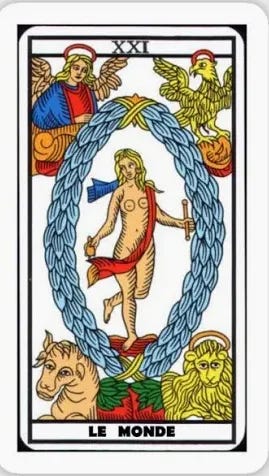
For the author of Meditations, the Tarot is not a mere complex of symbols for divining the future, but an “invaluable school of meditation, study, and spiritual effort.” Each of the arcana offer a lesson and a practice to embody. The World is the arcanum of analysis and synthesis. It teaches the art of distinguishing the illusory from the real, making it a sorting machine, much like Maxwell’s Demon, and quite an astute summary of Oedipa’s task.
As the novel unfolds, Oedipa becomes increasingly entangled in the intricacies of Inverarity’s estate. As she continues to pull at the mysterious threads tangled within, she quickly finds herself enmeshed in the secrets of a centuries-old private mailing firm called Tristero whose shadowy presence haunts the entire novel. She becomes obsessed with getting to the bottom of their identity. This obsession puts her in real danger of losing herself in the twisting halls of what you might call Chapel Perilous, “a psychological and spiritual state, often described as a liminal space between reality and delusion, where an individual confronts profound, reality-challenging experiences.”
Though she shows some vague and innate ability for sorting with Maxwell’s Demon, the field Oedipa is traversing becomes increasingly fraught. Any lead she follows threatens to swallow her whole, a dangerous situation when almost everything she encounters presents itself as a possible lead. Indeed, this is an aspect of art that we have turned to our advantage here at Gnostic Pulp. As with dreams, each detail therein can be tapped for that ever-ambiguous substance called meaning, but this meaning can never be exhaustively extracted. Dangerous enough when contained in an artwork, this becomes an existential danger when speaking of an aesthetic universe, that is, of a World that is art.
This idea is a touchstone in Pynchon’s fiction. He never tires of reminding us that is exactly the kind of world we live in. Nothing appears accidentally. Each object, every lowly artifact, from a used car to a lightbulb, has a history as vast and complex as our own. Oedipa’s husband, Mucho Maas, knows this. In fact, he is almost disablingly haunted by the fact that we are embedded in history, that material has memory, as is so beautifully illustrated in a scene in which a bottle of dandelion wine goes through a fermentation at the same time wild dandelions are blooming in the field, “as if they remembered.”
For Mucho, the weight of history is so crushing that it prevents him from holding down a job as a used car salesmen. The psychic and physical sediment that has accumulated in each vehicle is too much for him. He cannot stand to be near them. Since the Sacred has been cut off, his World provides him with no tools for dealing with the onrush of all this meaning, so his innate sense for it totally overwhelms him. Beyond that, the archons in Varo’s tower would prefer he not be so aware of such things, and in fact later in the novel this defect is taken care of through LSD trials in a wink towards MKUltra and the in-flooding of drugs used to disrupt and destroy any political movements or ideas that might have proven dangerous or irksome to the Tower’s continued production of reality.
This artwork They are commissioning is not one that is meant to be seen, but rather to conceal and control. One might imagine these archons sending out their agents to actively wipe any fingerprints history might have left at the scene, so to speak.
As Oedipa begins to dig into her assignment, Pierce Inverarity appears to be aligned with Them. He was a California land developer, after all, not exactly a sympathetic character. He had substantial holdings in San Narcisco, a city of which he is considered a founding father. There are several sections in the book referring to the natural landscape being stripped to a blank slate in order to be subdivided and suburbanized for his various developments, a step necessary in destroying the Sacred, as described by Mircea Eliade, who is invoked in this text by Pynchon’s multiple uses of the word hierophany, “the manifestation or eruption of the sacred into the ordinary, ‘profane’ physical world”, a word coined by Eliade.
Looking at Varo’s painting, it is hard not to see Inverarity in the window, peering down from his tower as bulldozers clear the land much like the freshly woven tapestry pours over and replaces the natural landscape. However, in the book’s most famous passage, Oedipa sees his project, San Narcisco, not as a town, but as a printed circuit. As something that can be mass produced. If that is the case, then perhaps Pierce is less archon than he is one of the weaving girls. He may be a founding father, but the founding father of a single instance of something that is practically plucked off the factory line. Each identical suburb can be said to have its own founding father, so zoom out a little and Pierce is a much smaller fish than he first appears. He may be visible in the tower window, but he is not in charge. He represents the ruling class of yore, the landed gentry coming up against the newly globalized cartels of control and capital coming out of World War II that are so thoroughly explored in Gravity’s Rainbow.
While he is not in charge, Inverarity’s position in proximity to power does allow him some insight behind the scenes. It may be that he is encoding messages into the fabric he is feeding out of the slot in the tower, a secret code for Oedipa to find and climb, like Rapunzel’s prince, so that she might get a peek inside.
The late literary sleuth, Charles Hollander, hints as much in his work decoding Inverarity’s name:
“‘Inver’ means ‘mouth’ in Gaelic; thus Inverness is the town at the mouth of the Ness, the river that flows out of Loch Ness. And a ‘rarity’ is. . . a thing of ‘unusual or exceptional character, esp. in respect of excellence.’”
While Hollander concludes that this means we can take the name to indicate that Pierce is a “smart-mouthed prick”, he glosses over his more important insight; if we return to the river mouth idea, then we see that Inverarity is the source, or mouth, for everything that flows out of this intrusion into Oedipa’s life. Furthermore, ‘rarity’ might indicate a rare river event, especially when placed so close to the word ‘pierce’, as if a dam has been pierced. Taking all this together, this gumshoe, at least, cannot help but think of a flood, and a rare one at that, maybe of the 1000 year variety, the kind that rearranges the world in its aftermath, maybe something. . . diluvian.
Is Pierce embedding clues in the fabric of reality in order to communicate to Oedipa that there is some force trying to remake the world to its liking? And should we, as readers, extrapolate some real world proxies? Pierce Inverarity, by all appearances, was a man in charge, but his death changes the way Oedipa sees her world. In looking into it, she reveals shadowy forces controlling the exchange of information who are secretly shaping things in the dark. Written in the mid-sixties, what other analogue could this be but JFK and the CIA?
At the same time, there is the possibility that Inverarity is just messing with her, that he really is just a smart-mouthed prick. He is certainly not above it. The last interaction Oedipa had with him, about a year before he died, was a 3AM prank call, so the whole trail of breadcrumbs he has left might be yet another, far more elaborate bit of trickery. Trickster reigns in liminal zones, after all.
Know who else is liable to follow breadcrumbs? Geese2.
Oedipa fears everything she goes through over the course of the book might well be a wild goose chase, and these two options are again corroborated by Meditations on the Tarot. Here, the anonymous author writes that the Arcana
“has its two aspects—a teaching aspect and a warning aspect. . . [The World’s] second, hidden name [is] ‘Folly’” (629).
Although it feels timeless, Meditations was actually written around the same time as Lot 49, and it senses the same ephemeral liminality as Pynchon. Making contact with anything real requires an act of sorting the shit from the clay. Anon visualizes this as The Sphere of the Holy Spirit and the sphere of mirages.
“But it does not at all suffice to distinguish the truth within this reality, i.e. to distinguish the action of the sphere of the Holy Spirit from the sphere of mirages. For the sphere of mirages, also, is real—but reality is one thing and truth is another thing. A mirage is certainly real, but it is not true; it is deceiving” (646).
While the World Varo’s tower produces is false in some sense of the word, it is very real in that a billion people live within its deception. While we here at Gnostic Pulp have some disagreements with the anonymous author over what might be categorized as a True World—he lists both gnosticism and Marxism in the mirage category— we can agree that a successful sorting must come through a pure longing for the truth. As he points out, chasing the ecstasy of revealing the truth will only lead you further into Chapel Perilous, as happens to any number of conspiracy-pilled people, and as is the looming threat for Oedipa Maas.
Their World
“Properly speaking, there is no longer any world,” Mircea Eliade writes in The Sacred and the Profane: The Nature of Religion.
“There are only fragments of a shattered universe, an amorphous mass consisting of an infinite number of more or less neutral places in which man moves, governed and driven by the obligations of an existence incorporated into an industrial society.”
Published less than a decade before Lot 49, Eliade is circling in the same waters as Pynchon and anon. While he contends modernity has done away with the Sacred and exists only in the profane, and I have claimed we are stuck in a liminality outside both the Sacred and the profane, we can agree on many other points, primarily that the World does not exist, or, if it does, it is not a true World in that it is not emitted from its inhabitants, but is applied from above, by the archons in Varo’s Tower.
That it is a tower is vital as it serves the necessary role of axis mundi, or universal pillar, which all Worlds, even false ones, require. An axis mundi is a structure that “at once connects and supports heaven and earth and whose base is fixed in the world below. . . Such a cosmic pillar can be only at the very center of the universe, for the whole of the habitable world extends around it” (Eliade 36-37).
That modernity’s tower has been hijacked by archons, by the capitalistic cabal, by Pynchon’s They, has repercussions for the rest of the lifeworld. Its center, the place from which it all flows, has been taken over and now produces a false fabric, not only without but within.
Quoting Joséphin Péladan, the anonymous author of Meditations writes that the deepest creation occurs not in anything material, but “in the abstract.”
“Neither Dante, nor Shakespeare, nor Goethe carried out evocations, and all three understood the occult; they were wisely content to create eternal images; and in this they were incomparable mages. To create in the abstract, to create in the souls of men, vivifying reflections of the mystery—this is the great work” (628).
This is the lesson the archons have taken to heart and the true strength guaranteeing the tower’s existence. It is something Pynchon explores in all of his work, the nefarious implanted systems of control, the replicated tower within. Eliade writes about how a world reproduces itself at every level, as above so below, the cosmic and the personal. The kingdom They have created is within you, as evidenced in-text by the pedophilic tendencies of a heavy percentage of the male characters, including Oedipa’s own husband, her co-executor who runs off with the teenaged girlfriend of one of the boys in the band, The Paranoids, spurring him, in turn, to pen this song:
“And the older generation
has taught me what to do—
I had a date last night with an eight year-old,
And she’s a swinger just like me”
It is an obsession with control, objectification, and profit extraction that is entwined in the very fabric of our false world. It shapes not only the economy, but the people living under its influence. In the fallout of Epstein, one can see quite clearly how deep and widespread is the rot.
SAGE
If we want an actual, physical axis mundi, some nexus point to trace this all back to, a hierophany where this false World intruded, we might look towards the obelisk of black lava rock that now stands at the Trinity Test Site.
The Manhattan Project which produced the atomic bomb is the wellspring of so much of modern technology; it accelerated advancements in computing, medicine, and materials science, so that its imprint is within nearly all consumer technology to this day. We have lived in the atomic bomb’s World since that first test on July 16, 1945, exactly as David Lynch shows us in the famous sequence in Twin Peaks: The Return. The first nuclear explosion created or at least cemented the intrusion into what once was our World, and it is out of this explosion that the false World has flowed.
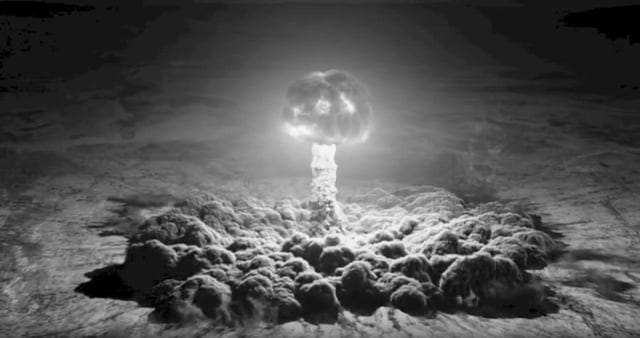
One of the entities that rode that flow, alongside Judy and Bob and all the rest, was the internet. The first prototype for a SAGE (Semi-Automatic Ground Environment) Direction Center was up and running by 1955. Over the next decade, twenty-two more would come online, and I mean that quite literally as SAGE is the earliest ancestor of the internet we have today. That’s right, kids. Ol’ Grandpa Internet started as an air defense system, an interlinking of radar and launch sites that blanketed the United States, and could respond to threat from anywhere on the network in case central command had fallen:
“SAGE was a system of large computers and associated networking equipment that coordinated data from many radar sites and processed it to produce a single unified image of the airspace over a wide area. SAGE directed and controlled the NORAD response to a possible Soviet air attack, operating in this role from the late 1950s into the 1980s.”
These stations were connected by dedicated cable that provided the first electronic messaging capabilities. Quite rudimentary by today’s standards, but bleeding edge at the time. Few would have known about it, but perhaps Pynchon’s time at Boeing got him hip to this electronic net that was ensnaring the nation. The whole underground W.A.S.T.E. messaging system could be a nod towards just that, or so sez Mike Judge.
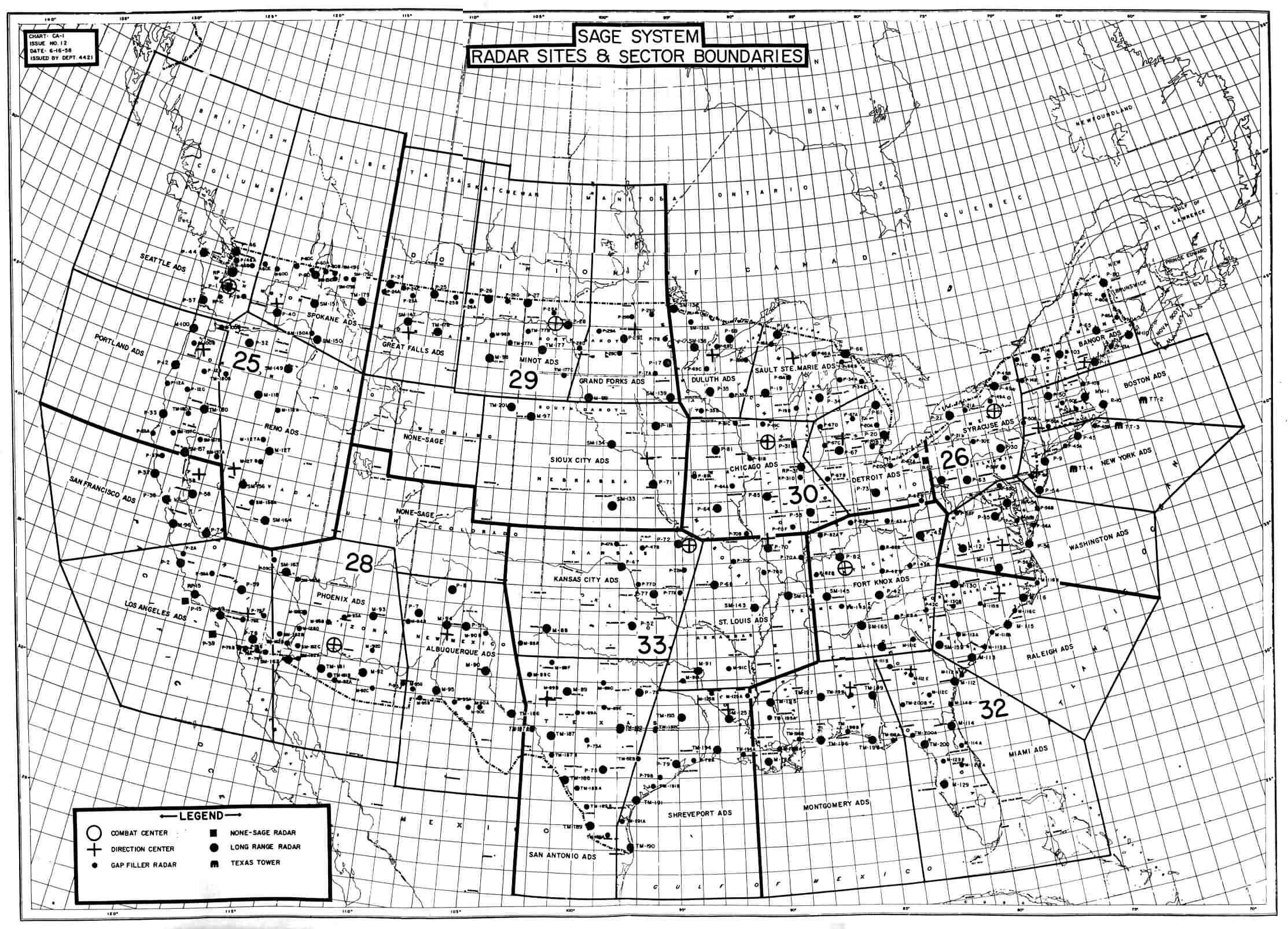
So the internet began as a vast surveillance system with a kill switch that could initiate nuclear armageddon. Its cables tunneled underground and its radar cloaked the sky, mimicking the three-layered cosmic unity traditionally provided by an axis mundi, but rather than tying a People into The World and creating a holistic and meaningful worldview, this one exerted total surveillance and control, an all-seeing eye with a knife to the planet’s throat.
JFK threatened this new World’s prime reason for existence by seeking to destroy the CIA and cool tensions with the Soviet Union, and that could simply not be allowed. The archons acted, but in response awoke a counterforce.
We’re Gonna Need a Bigger Archon
One gets the feeling that in 1964, Black Iron Prison Inc. was riding a high. Who could blame them? The fifties had been going just swell; if only they could stamp out those pesky jazz cats, things would be perfect. They had just gotten away with killing the damn president. Surely no one could touch them. Besides, with the surveillance technologies coming down the pipeline, automation was already underway. They had been forced to hold things in place through their own strength for so long, but now the undergirding of a new system of control had begun to be put in place, one their forebears could scarcely imagine. This system could do the heavy work for Them.
So maybe they got a little lazy, or perhaps they underestimated the complete pacification of the citizenry just a bit. Either way, there was a brief lapse in their reign, and that is why it is so important that Pynchon set the book in 1964. It is the most contemporary book in his bibliography, one of the few times he has commented so directly on what was practically the present moment, and it has remained a breakpoint that he returns to throughout his career.
What gets called The Sixties for simplicity’s sake actually began in 1964. The start is popularly pegged to the debut of The Beatles on The Ed Sullivan Show, and continues on until Nixon’s resignation in 1974. This is the famous decade that is so often invoked as an era of total revolution, of free love and the freeing of the human spirit, yaddy-yadda.
The Sixties™ have been repackaged and sold back to us for so long and in so many ways that the real thing is almost totally obscured behind its simulacra, but, however briefly, it seems there really was a true sense that everything was on the verge of change, that a window long-shut had been pried open if even just enough to get a sniff of the fresh air on the other side.
Oedipa gets a sense of that feeling over the course of her investigation. There are true counterforces taking shape, worlds within worlds. Those who, like herself, have seen the inside of the tower could not simply go back to their old way of life.
However, this open window would be slammed back down with extreme violence in what Michael S. Judge in his incredible reading of the book has named The American Reconquista. These are the years in which the archons in The Tower roll out their whole array of new weapons and technologies in response to the counter cultural threat. The Tower would be reinforced. Newer and more powerful technologies of surveillance and control would alloy the fabric pumped out by the imprisoned weavers.
What Oedipa sensed, what she was actually chasing, and what initially catches the nose of so many who wind up lost in Chapel Perilous, was not really a single conspiracy. Discovering the full history of Tristero would not provide the balm she longed for, nor would pinpointing Kennedy’s assassin, for it is the very falsity of her world that Oedipa has got the scent of; it is the obelisk studded in the desert, pouring out its fabric to cloak the earth. For those who peer inside, the vision is so dire that they will sound crazy when they try to deliver the message to the people back home. Simply glimpsing the truth is not enough to redeem the World.
What a World needs is some kind of Sacred connection, not a state religion, not even necessarily religion at all. The right approach to science could probably provide it. It is simply a connection that brings the human into contact with the cosmic, that gives meaning to life by consecrating the past and the future. Oedipa’s quest was never meant to save the World. If she manages to successfully sort the real and the false, which is a question that remains open at the end of the novel, she will still have to live within the same World as before. With her new knowledge, this is in some ways a worse situation than she was in to start with. She will have returned to the beginning, but at a higher level, climbing the cyclical spiral journey of the Tarot, ready to perform as a more able Magician for her next go round.
As Alejandro Jodorowsky writes of the arcanum, it represents the anima mundi, a sort of individual rather than societal connection with the Real. The Dancer, “freed from self-destruction. . . begin[s] to glimpse the suffering of the Other and put[s] [them]selves at the service of humanity.”
The World must be redeemed not in the Sacred realm of Tarot archetypes, but down here in the profane, in the flow of history, by us. Realizing our situation is only the first step towards what Oedipa’s friend, Jesús Arrabal, calls ‘an anarchist miracle’. Here we might take ‘anarchist’ in the sense that it is not a World prescribed from above, but one built from its base, and with no ulterior motive, but simply as shelter from the storm for all those who dwell within, human and otherwise.
A miracle, indeed:
“You know what a miracle is. Not what Bakunin said. But another world’s intrusion into this one. Most of the time we coexist peacefully, but when we do touch there’s cataclysm. Like the church we hate, we anarchists also believe in another world. Where revolutions break out spontaneous and leaderless, and the soul’s talent for consensus allows the masses to work together without effort, automatic as the body itself. And yet. . . if any of it should ever happen that perfectly, I would also have to cry miracle. An anarchist miracle.”
[Exit Music]
“A philtre (or philter) is a potion, charm, or drink intended to induce love or desire, often used in romantic literature and mythology. Derived from the Greek philtron (”love charm”), it generally refers to magical concoctions, such as in the story of Tristan and Isolde.”
This is not a comment on the discourse, but on the animal itself. I have no idea what Cameron Winter’s reaction would be to breadcrumbs.
The tapestry that becomes the world also made me think of this short story by Borges who as you know was saturated in Gnosticism
"Of Rigor in Science"
...in that Empire, the art of Cartography attained such perfection that the map of a single province occupied the entirety of a city, and the map of the Empire, the entirety of a province. In time, those unthinkable maps no longer satisfied, and the Cartographers' Guilds drew up a Map of the Empire whose size was exactly that of the Empire itself. The subsequent generations saw that that vast map was useless, and not without some pitilessness they delivered it up to the inclemencies of the sun and of the winters. In the Deserts of the West, still today, there are tattered fragments of that Map, inhabited by animals and beggars; in all the land there is no other relic of the Disciplines of Geography.
There are other Borges fictions and poems that reflect a similar sense of blurring of scale representing the fictional or artistic depiction becoming its own world. Gnosticism for Borges was often a vehicular symbol for concepts around creating art and fiction and their relation to dreams and metaphysics, and I suspect that Pynchon was borrowing this Borgesian feel for a symbolic excursion into Gnostic symbolism.
Thank you for this post. I’m reading crying lot and now it’s taking on new meaning. Love this