
Shell Game
On Panpsychism

This piece was previously published by a journal who advertised themselves as a paying market, yet did not pay, so I am republishing it here…behind my own paywall. If you’ve enjoyed Gnostic Pulp consider upgrading to a paid subscription to unlock this + bonus posts like it every month.
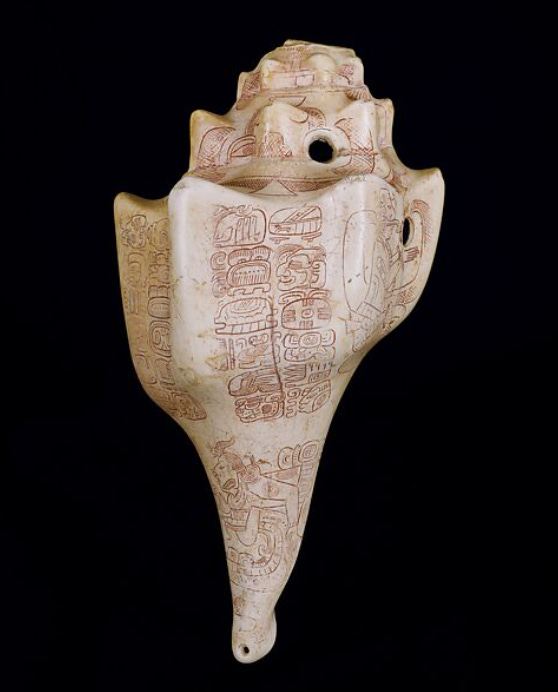
In the summer of 2023, the Kimbell Art Museum in Fort Worth, Texas hosted a traveling exhibit called Lives of the Gods: Divinity in Maya Art. One of the items on display was a conch shell trumpet. It sat alone, under halogen bulb, in a sterile glass box. The plaque and the voice on the audio tour recording reported that the Maya considered such objects to be ensouled. Undoubtedly, it emitted an entrancing presence, sad yet powerful, like many of the artifacts on display. Though they are revered pieces, as they must be to have been included in the exhibit, something felt amiss.
The pieces were displayed in the second building of the museum. The permanent exhibit in the main building is free and showcases a range of works, including many pieces from that small class of artists who have attained the rarest of statuses, that of becoming a household name.
The second building requires the purchase of a ticket and often houses more niche exhibits which attract smaller crowds. For that reason, these rooms are often sparsely populated. Each piece is given a large buffer of space.
The Lives of the Gods exhibit included sections of stone wall cut out of temples standing ten feet tall and weighing a dozen or more tons, as well as palm-sized figurines carefully carved in jade. There were stone sculptures of sacrifice victims and statues in the likeness of a whole range of gods, but it was the conch shell trumpet located in the second room of the exhibit that continued to draw me back.
It was a large shell, but still small enough to fit within a neat glass cube, probably 2x2x2, give or take, sitting atop a pillar. One could observe every angle by walking around the pillar. Had one never seen a shell or did not know how commonly the sea spat out her gifts, the shape itself would appear museum-worthy even without the visible etchings or ethnographic context.
Poet Paul Valery, in his book Sea Shells, writes that “a sea shell emanates from a mollusk. To emanate strikes me as the only term close enough to the truth since its proper meaning is: to exude. A grotto emanates stalactites; a mollusk emanates its shell” (65).
The queen conch is a species of sea mollusk famous for her shell which today can be found in beachside souvenir shops the world wide. She grows slowly: born as a tiny, larval thing, the snail burrows into the sand where it stays, metamorphosing into a tiny version of its adult form which will unfurl, loosening a spiral that will expand for four years and then spend another twenty thickening, composite layers alloying season after season.
Living within the whorl, this softest of creatures imprints its body upon the hidden interior, sanding it to a pink, enamel-smooth surface, twisting away from the world in its spiral chamber. In this it is like the soul itself, that irreducible core that remains even after the acid wash of death upon which it returns to the commonwealth of all things. The soul makes hardly an appearance in this life. It dreams, and in this dreaming it exudes a second soul, what might be called the operational soul, Spirit, or Self. This is simply an accumulation built up around that hard stone. The soul emanates a Self, the living, thinking spirit that has opinions and feelings and desires. It is the Self that is at the wheel, though the Self, of course, cannot survive death. Caught between an emanation from within, and the limitations exerted by material conditions without, the Self is made, like the conch shell, both armored and beautiful. Valery writes of the dual consciousness of the conch, living both within his shell and in the world:
“Here we are tempted to credit [the mollusk] with a genius of the first order, for he must confront two utterly different realities accordingly as he closets himself in laborious, concentrated aloofness to coordinate the efforts of his mantle, or as he ventures out into the vast world and explores it, his eyes groping, his feelers questioning, his firm foot with its broad viscous sole supporting the majestic traveler and his sanctuary, rocking them to and fro. How is he to combine, under a single set of principles and laws, the two kinds of consciousness, the two forms of space and time, the two geometries, and the two systems of mechanics with which these two modes of existence and experience alternately confront him?” (95-96).
And so it is for us all: interior and exterior, mollusk and shell, soul and self, sleep and waking. There is something incomplete about visiting an art museum, some sense that one should be doing something more. This, perhaps, has to do with a blurring of these two utterly different realities, for it is a Hercules-in-Hades experience to walk amongst masterpieces. All of one’s dayworld strengths have no power in the nightworld of art. Sylvia Plath broaches the subject in her poem, The Ghost’s Leavetaking, writing of the moment of falling asleep as
“At this joint between two worlds and two entirely
Incompatible modes of time, the raw material
Of our meat-and-potato thoughts assumes the nimbus
Of ambrosial revelation”.
That about sums up the feeling of incompleteness which is essentially correct, for the physical visitation is only the beginning. Time will work to unfurl these meat-and-potato thoughts, alchemizing experience into ambrosial revelation somewhere down in the unknown subconscious.
