
Moby-Dick is About Anamnesis
On Ottessa Moshfegh's "McGlue"

While participating in the Weirdosphere course on Moby-Dick, I have been struck by the range of my classmates’ interpretations. We are all studying the same text, but each reader seems to be having their own, totally singular experience. Of course you could say this is true of every book1, but it feels somehow especially true of Melville’s masterpiece. Just as every hue is stitched tight within the whiteness of the whale, the book seems able to accept every interpretation without ever being interpreted.
For that reason, I have decided it would be fun to continue my “Moby-Dick is About ____” series. This project began last year with Moby-Dick is About UFOs in which we covered Cormac McCarthy’s deeply Moby-inspired text, Whales and Men. Today we continue with the second entry of the series which will be tackling Ottessa Moshfegh’s 2014 novella, McGlue.
Like McCarthy’s screenplay, McGlue is haunted by the specter of Moby-Dick. Yes, The Whale looms so largely in American literature that an author can hardly write about the sea without drawing the comparison, so you might as well lean into it, as Moshfegh does. She sets her nautical tale in the year 1851, the very year Moby-Dick was published, and McGlue, the titular character, is sometimes referred to as Mick, which is clearly just Moby Dick with the “oby D” omitted. Read aloud, this, of course, sounds like ‘obeyed’ which might remind an astute reader of exactly what Jonah failed to do, but we’ll just put a pin in that for now. . .
It’s all in good fun to go fishing for esoteric connections, but there is an important and rather obvious reference that appears on the very first page:
“My head. Just last spring I cracked it jumping from a train of cars” (1).
The cracked head is an important image in one of the most well known lines from Moby-Dick:
“Heaven have mercy on us all—Presbyterians and Pagans alike—for we are all somehow dreadfully cracked about the head, and sadly need mending.”
What is truly strange, though, is that these aren’t just neat references a young author was making to one of the foundational texts of her nation’s literature. These details are historical fact. As Moshfegh told the Chicago Review of Books, she found the inspiration for this story in the periodical archives at the library:
“And then I come across this tiny little announcement that’s titled McGlue. It went something like this: McGlue from Salem has been acquitted of the murder of Mr. Johnson in the port of Zanzibar, due to his having been out of his mind, at the time of the crime, because he was in a drunken blackout, and had suffered a head injury from… jumping off a moving train, several months earlier.”
In the Brig
If you have not read McGlue then the preceding description sums up the bare bones of the plot pretty well, but what makes the novella work is the mood Moshfegh imbues it with. It’s a nasty little book, as is her style, but it is shot through with moments of dazzling beauty thanks to Moshfegh’s prose, which is really quite astounding here in her debut. The narration picks up after the crime and takes its focus, instead, on McGlue’s slow journey towards confession. As for McGlue himself, he is no lovable Ishmael. Imagine, instead, someone closer to the drooling guy being held in the drunk tank in Twin Peaks: The Return.

McGlue is also being held in custody, but, rather than the Twin Peaks sheriff’s department, he is in the dank brig of a nineteenth century ship. He is not sure why he is in jail. In fact, he seems to have very little recollection whatsoever. When he is told what he did (murder his friend, Johnson, allegedly), he does not seem capable of registering the idea. He is so out of it that he is not even sure if the stain on his shirt is dried blood or mud. Hell, his own name comes to him as something of a surprise:
“‘McGlue!’
This McGlue. It sounds familiar” (1).
Everything from outside seems to thud against some defensive layer. This is the protective functioning of an overactive Self. It is the Self’s job to preserve our sanity and to maintain our reality system. At its unhealthiest, it can warp our entire worldview in order to protect our self-perception as perennial Good Guy. Every accusation might be a confession, but only we have the direct, lived experience and interior knowledge of our own actions, and with all this raw data we can mount any defense, endlessly weaseling our way out of ever internalizing responsibility.

McGlue’s mental defenses are impenetrable. Any attempt to draw a confession or even ask a question just bounces off of him. He stews in his filth, hallucinating, cracking wise, tossing about slurs, and bumming drinks however he can. This is the mind we occupy throughout the novella. Cracked upon the train tacks and pickled in rum, it moves seamlessly through time, dream, and hallucination. It seems he is totally incapable of sobering up, in part because his captors continue to supply him with a variety of booze, but mostly because his constitution is set against sobriety. He tells us at one point that even as a kid he had ways of getting fucked up without alcohol, including auto-asphyxiation and holding himself upside down until all the blood would rush to his head, so, when his captors fail to provide him with anything to drink, McGlue is more than willing to go analog by poking around in that crack in his skull, pushing the buttons on his brain until he triggers the desired effect of blacking out.
What Was That About Jonah?
As Moby-Dick’s Father Mapple discusses in the sermon he delivers to those gathered in the New Bedford Whaleman’s Chapel, Jonah tried to hide from God. He was called upon to travel to Nineveh and proselytize, but he refused and instead hightailed it in the opposite direction, hoping to hide in the distant, Godless land of Spain.
McGlue confesses to something similar:
“There was a time I knew there was a god hearing my thoughts and I was careful what I let get said and there was a time the shame of what I heard up there made me bang my head against the wall” (60).
For Jonah’s disobedience, God sent a storm to threaten the ship carrying him which only ceased when he was cast into the water where he was immediately swallowed up by a big fish2.
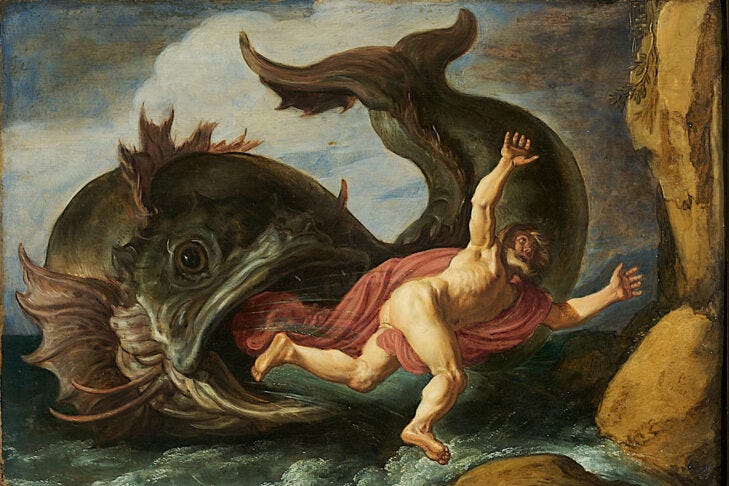
It is not hard to draw a parallel here: Jonah disobeyed God and wound up in the belly of a whale; McGlue is accused of murder (thereby breaking one of God’s commandments) and winds up in the brig. They are both given time to think about their sins. Jonah comes around to his rather briskly, in that ellipsied fashion of myth. The whole Book of Jonah takes up only two pages, and by the top of the second page he has already ignored God’s call, been cast into the sea, swallowed by a whale, experienced his dark night of the soul, and had his moment of redemption:
McGlue, meanwhile, needs a bit more time. While it is a rather short book, it is magnitudes longer than The Book of Jonah, and McGlue is a deeply stubborn and repressed character. Though he fights desperately against it, all outside forces are pushing him towards anamnesis, an unforgetting. He must face the reality of his crime and confess, or he will remain forever swallowed up inside his whale.
Anamnesis
While some readers may be familiar with the word ‘anamnesis’ thanks to Philip K. Dick’s 2-3-74 Experience, it may be all Greek to many others. In fact, it is a Greek word, derived from ana (“again” or “back”) and mnesis (“memory” or “mind”). Literally, it means remembrance, but it carries a heftier connotation than mere recollection. In the Gnostic tradition, it means a remembrance of one’s divine nature. Rather than original sin, there is original salvation, if only it can be remembered. What prevents this remembering is the crack in the skull in need of mending.
Ishmael, for whatever reason, seems innately attuned to his true nature. When he hears God’s call, he does not run. He is aligned with Divine Will, whether it comes from his own God, or his friend’s idol, who he trusts to guide him to the ship they are meant to sail on:
“Queequeg now gave me to understand, that he had been diligently consulting Yojo—the name of his black little god—and Yojo had told him two or three times over, and strongly insisted upon it everyway, that instead of our going together among the whaling-fleet in harbor, and in concert selecting our craft; instead of this, I say, Yojo earnestly enjoined that the selection of the ship should rest wholly with me.”
It occurs to me now that maybe Ishmael’s acceptance is not exactly so innate as I first thought. Remember, he is writing his account in retrospect. Perhaps when he actually lived through all this it was with some consternation, but, while floating along upon Queequeg’s coffin amongst the ruins of the Pequod surrounded by that vast void of open water, he underwent his own anamnesis, and in so doing retroactively adjusted his lived experiences, or else gained something akin to total recall, giving him the ability to go back in his memories and experience them again with this new, expanded insight in a way not dissimilar to time travel. What else might account for the incredibly lucid details Moby-Dick is comprised of?
Is, then, Moby-Dick About Time Travel?
But no. Let us not go down that rabbit hole today.

Anamnesis breaks the frame of Self. It lets us see ourselves from outside as Other while at the same time gives us a glimpse of the inside of Other-as-Self. This could be how Ishmael taps into his peculiar “first person omniscient” perspective.
This sort of blurring of identity is all over Moby-Dick. We get a beautiful illustration of it when Ishmael and Queequeg are monkey-roped together, Queequeg hanging off the side of the boat, stripping a whale while Ishmael has him anchored around his waist:
“So strongly and metaphysically did I conceive of my situation then, that while earnestly watching his motions, I seemed distinctly to perceive that my own individuality was now merged in a joint-stock company of two: that my free will had received a mortal wound; and that another’s mistake or misfortune might plunge innocent me into unmerited disaster and death. And yet still further pondering—while I jerked him now and then from between the whale and the ship, which would threaten to jam him—still further pondering, I say, I saw that this situation of mine was the precise situation of every mortal that breathes; only, in most cases, he, one way or other, has this Siamese connection with a plurality of other mortals.”
What Ishmael admires in Queequeg when they first meet (that he “seemed entirely at his ease; content with his own companionship; always equal to himself”) could equally be applied to himself. Perhaps it is for that reason that the two get along so easily, becoming overnight bosom friends who split their money down the middle, stay up late to gossip in their shared bed, and leisurely throw their arms and legs over one another, as totally at home with each other’s bodies as they are with their own, because, in some sense, they understand that they are not entirely separate, but united in their divine nature.
Much has been speculated about the possible sexual nature of this union, as has been of Melville’s own sexuality. Was he in love with Nathaniel Hawthorne? Did he sublimate all of that repressed attraction into the creation of Moby-Dick?
While we cannot speak for Melville, we can pretty safely say that McGlue has deeply buried his own sexuality, and that might lay at the root of his issues. Sure, he may have spent some time turning tricks with other men, but that wasn’t gay. It was in exchange for money and booze. Okay so the sight of the female body might disgust him, remind him of the smell of fermented cabbage and soured milk, make him feel smothered, oppressed, and panicky, but that’s just guy stuff, right fellas? He still reviles homosexuality anytime he suspects it in another. This is the nineteenth century, after all. Not only that, but he hails from Salem, a place where the memory of those who were seen as different being burned at the stake must still be fresh on the mind. So he deeply buries that part of himself, maybe so far down that even he is not fully aware of it. Nonetheless, this repression curdles something in him at a structural level.
One gets the feeling that if it were McGlue who walked into The Spouter Inn and was told he’d be sharing a bed with Queequeg, things might go a bit differently. If anyone tried to throw their legs lovingly over his, he’d probably stab them in the heart then go off somewhere to finger his brain.
Cracked
In our Moby-Dick class, we were invited to ask ourselves how exactly God commanded Jonah to go to Nineveh. There is nothing about him appearing as a burning bush or in any other corporeal form. Instead, we get the simple introductory line: “Now the word of the Lord came unto Jonah.” Was it simply a feeling? Did he feel, as modern Christians are fond of saying, called to do something? Is it the same kind of inner longing that delivers Ishmael to sea? Or that same faint prickling that sometimes agitates McGlue’s conscience?
Was McGlue’s call from God really just to remember his crime? Or has it been repeating itself ad nauseam for his whole life, like a distress signal, to accept himself for who he is?
Either way, his continued refusal lands him in the belly of the whale where he has such ample time to think that even a mental gymnast as skilled as himself starts to slip. As he is transferred from the brig to an actual holding cell in a Salem prison, his conscience manages to land a few good blows. In his new cell, he finally loses the security of his alcohol blanket, and sober memory threatens to come in for the knock out punch:
“Something has altered beneath the few still live wires on the surface of my brain. I am beginning to be thirsty for something more. I can barely explain it. And I feel I don’t know anything. I never did, as a kid or man, nothing. I always refused to learn” (90).
It takes one hundred thirteen pages for McGlue to do what it took Jonah only a handful of paragraphs: pray. When the realization of Johnson’s death finally sinks in, he has no where left to turn. He admits that no kind of drink could “Take the stink out of this one…Johnson’s dead” (113). But even then, he does not pray for relief, for forgiveness, guidance, or any of the rest; he prays to die.
Having finally accepted the reality of Johnson’s death, he still manages to squirm away. Rather than face the facts, he inserts a knife into the crack in his head and starts twisting it around. Somehow this does not kill him, but when again he wakes up he has been transferred to a hospital or sanitarium and become totally unstuck in time, and possibly paralyzed, or at least tied up.
It is only in this state that he actually experiences anamnesis and can finally recall the full details of that fateful day.
Johnson knew McGlue well. They’d been traveling together for a long time. Surely he must have known how his friend would react when he professed his love to him. You see, Johnson, too, had hidden his sexuality from the world, but not, like McGlue, from himself. Still, he understood it was a love that could never be requited, not in their world, and living in such a way was destroying him. When he confessed, it was because he wanted McGlue to kill him.
“‘You or me?’ I ask. ‘One of us has to go,’ one of us says.
His knife is pretty and he says, ‘Just go ahead and do it.’ My rigging knife is rusty and he sees it and says, ‘Just go on’” (144).
At least that is how McGlue remembers it.
This ambiguous ending might leave some readers disappointed. Obviously the guy is a monster, right? His moment of anamnesis was meant to either prove him innocent or, if he is guilty, then it should have awakened a higher self who could play the role of inner judge, someone who could deliver the only sentence that might get through to him: a miserable conscience, but we get neither. McGlue severs his conscience with the knife leaving us with only a muddled answer. His anamnesis is neither redemption nor condemnation. The aperture has become too large for either. In a sense, McGlue is able to squirm away yet again, but in another sense McGlue no longer exists. Like Pip, his individual identity has been overwhelmed. This dubiety may well leave the reader with an uneasiness, but why? What is that exactly? What ending would have satisfied that part of us?
Here we might turn again to Jonah, to the second two chapters, which Father Mapple does not touch upon. After the whale spits Jonah out on the beach, he finally goes to Nineveh and does as asked. Much to Jonah’s chagrin, the people actually listen and repent. After all he has gone through, he had been hoping to at least witness a good divine demolition of a debaucherous city, but no. Now God is going to show mercy? Where was that mercy when you sent Leviathan to eat me?
This resentment might serve as a good reminder that Melville’s quote implicates us all. The crack is not simply McGlue’s, nor Nineveh’s. These are people who, as is written in The Book of Jonah, “cannot discern between their right and their left hand.” Meaning, the fault, the crack, extends into The World that made them. That crack in the world, ye ol’ Black Iron Prison, surely would have prevented McGlue and Johnson from ever living their love openly, so Johnson says what Jonah says, “It is better for me to die than to live.”
That longing, that thirst McGlue feels for something more, is beyond personal salvation. It is a longing for universal redemption, for the crumbling of the Black Iron Prison. Like whale oil, anamnesis might provide light, but sometimes light does nothing more than illuminate a small bubble that exposes a vaster darkness.
Near the end of the famous forty-second chapter, The Whiteness of the Whale, Melville writes about just such a type of anamnesis:
“Tell me, why this strong young colt, foaled in some peaceful valley of Vermont, far removed from all beasts of prey—why is it that upon the sunniest day, if you but shake a fresh buffalo robe behind him, so that he cannot even see it, but only smells its wild animal muskiness—why will he start, snort, and with bursting eyes paw the ground in phrensies of affright? There is no remembrance in him of any gorings of wild creatures in his green northern home, so that the strange muskiness he smells cannot recall to him anything associated with the experience of former perils; for what knows he, this New England colt, of the black bisons of distant Oregon?”
As we see with the colt, anamnesis does not always mean the awakening to camaraderie that Ishmael experiences. It dropped Philip K. Dick into the bottomless pit of Chapel Perilous, turning his final years into a desperate, Ahabian search for meaning. Indeed, Ahab is a much closer analog for McGlue than Ishmael. There is no easy fix for either. In that sense, these two are Gnostic heroes. They see that the world is fallen and false.
Any true mending for McGlue would require massive societal change. Perhaps this is what accounts for the few stray references to Hong Xiuquan, the leader of the Taiping Rebellion that was just beginning, half a world away, at the time this novel is set. Xiuquan, who claimed to be the younger brother of Christ, really was remaking the world. His rebellion mobilized peasants, destabilized the Qing Dynasty, and established the Taiping Heavenly Kingdom which ruled over a huge swath of southern China, encompassing upwards of 30 million people beneath its banner. While it lasted, Xiuquan remade society into something of a proto-socialist vision, albeit with theocratic characteristics, but in the end it fell in an unfathomably bloody conflict that claimed more lives than World War One.
While some lucky few might find divine satisfaction amongst their fellow man, there are others in whom that cranial crack is cloven all the way through. In that way, McGlue, Xiuquan, and Ahab are all connected. None can find any earthly satisfaction. If they are to have comfort, it seems it will have to be ripped from God’s own hands.
As Ahab asks, "How can the prisoner reach outside except by thrusting through the wall?” Whether that wall be a whale, centuries-old dynastic rule, or the few inches of skull separating the brain from the open air is totally up to circumstance. Punching through it may lead to freedom, but it will necessarily be a self-annihilating freedom.
What say ye, men, will ye splice hands on it, now?
[Exit Music]
or even each reading of any book, as this time through my experience has been far different than my previous.
As we know from reading Melville, whales are a type of fish, and the only whale present in the Mediterranean, however rarely, who could swallow a human being whole is the sperm whale
Another winner! McGlue reminds me of Camus' The Stranger.
U rock