
Only an Egregore Can Save Us
On Brian Evenson's "Leg" and Michael Cisco's "Hand of Glory"

Oh journal, I must confess to thee or else go mad beneath my most recent revelation! In the course of my usual studies (namely pouring over the revealed literature of the Gnostic Pulp tradition in order to map the contours of the Black Iron Prison), I uncovered an astonishing secret that I dare not share with any breathing mortal, so I pen it here instead: there exists a cell of weird fiction writers who are raising an egregore in order to carry out their unknown bidding.
I know how this sounds. Of course I tempered my initial paranoia with cold reason, but that reason was shortly blasted out of me. I could not deny what I saw. As sickening acceptance settled over me, my initial response was to sound the alarm, but I stayed myself. Though I must confess, originally this was only out of fear, for I dared not cross such a monster. You see, this being they have brought forth, or are in the midst of bringing forth, I do not know which, is of such vast and horrible proportion that, even after frantic investigation, I have still only glimpsed a single hand and a single leg.
Is it that this is all they have yet activated, or does their servitor exist on such a scale that my eyes could not behold the full breadth of its stance? I do not know. Though I have not slept and done little more than scour my humble library for further hints, I have failed to locate its other two appendages (if indeed only two more it has) nor its animating head. Like a paleontologist who happens across an ancient bone some millennia removed from the rest of its skeleton—I hope! I hope like a scientist and not like a dog with a bone, for it would make me a mad dog indeed— I have had to piece together the rest with what knowledge I have, and that knowledge tells me any alarm would be useless. This being, once raised, will not be stopped. Cannot be. The machinations of this league of writers have been as careful as they are powerful, so that I feel certain that, whatever their intention, it will be fulfilled.
If it wasn’t for my meddling deep in that section of the library, and a bit of lucky (or perhaps unlucky) happenstance, I am sure they would have carried their task out in total secrecy. Their creation might even now move amongst us, bending its masters’ will towards reality, unseen despite its massive stature, for it possesses an obscene cloaking ability, and is capable of moving through a medium unglimpsed by us sweet dwellers of the dayworld. And these are only some of the powers granted by the two known limbs. Who can say the scope of its full capacity?
Call me a coward if you will, but I have chosen to put my faith in this brute. Too long have I scurried the corridors of the Black Iron Prison like a rat, searching for any seam through which I might squeeze. Let us for once match might with might. Arise, ye young titan, and may your unseen head pierce this false sky; may your arms bend black metal and allow the true light of the sun to wash against our paled faces; arise and fulfill your fate; wrestle the demiurge to the ground, and smite him his final blow!
Leg
It is common practice in secret societies for one cell to have no knowledge of its brother cells, or even for one member of a given cell to be uninformed on the activities of another of that same cell, for the left hand to not know what the right is doing, to borrow a fitting phrase. This is meant to protect the collective. If one is discovered, they cannot be forced to disclose anything about the others, for they know nothing. In such a fashion, I believe these writers are working, for their texts give no indication as to who else might be involved. Instead, each writer has been tasked with the sole purpose of manifesting a single body part. Not only does this protect the larger project, but it will endow the being, when it comes together, like Megazord, with an incredible amount of psychic power, for each limb will have been lovingly crafted. Beyond that, they seem to have chosen writers with healthy readerships, and it will be these readers’ focused attention that further charges the given limb, so that I shiver to imagine the being in toto.

The first glimpse I received caught me totally off-guard. As I have said, I had snuck down to my library for a bit of reading of the usual sort when the leg stepped down hard right in front of me. It was a single leg, psychically projected directly into my reading room. I marveled at it, and wondered if it could see me in return, but I don’t think it was truly there. I believe some force was giving me a special vision, though for what purpose I cannot say. Still, I dared not move until the vision dissipated. At the time, I did not know what the hell to make of this apparition, and naturally feared that I might have simply lost my grip, but soon I would begin to piece it together.
The manifestation of this first limb had been trusted to none other than Brian Evenson, one of the living masters of the new new weird, or whatever we want to name this crop of artists who are currently working at the height of their powers. He will give it a fatal charge, indeed. Few writers of strange tales can point to a generator more potent than Evenson’s official excommunication, not direct from the Pope, but from America’s own Rome out in Utah.
This leg bookends his collection, The Glassy, Burning Floor of Hell, starring in the opener, appropriately titled Leg, and reappearing in the last and titular story. If this double appearance as both alpha and omega was not enough to draw my attention, then the obvious Moby-Dick references certainly did. Recently I have been deeply immersed in a careful reread of that foundational text, and will be the first to admit that I have grown liable to draw connections with it anywhere and everywhere, but these associations were too direct to mistake, and it makes good sense. If they are going for power than what tappable source more bountiful than the leviathan himself?
In Leg we have the story of a starship captain named Hekla who, like Ahab, wears one false leg. Unlike Ahab, Hekla’s leg is not simply derived from the bone of a living creature, but is itself a living creature:
“When she needed to walk about her vessel this served as a leg for her, but once she was alone in her quarters she would unstrap it and it would unfurl to become a separate being, something she could converse with, a trusted advisor, a secret friend” (1).
We receive only scant details of this leg’s origins. It first appeared to Hekla, as a being “made of angles and light”, directly after she lost her natural leg, volunteering itself to play that role for her, and thereby saving her life. It then served her well for many years before eventually revealing to the captain its knowledge about a space-dwelling creature of titanic proportion, something that might be a worthy foe that the captain might like to hunt:
“‘On the winds of darkness is a creature as long as this vessel, and that moves in a slow, undulating pattern across the currents of space. Its back is quivered with spines, and it is long and thin like a snake but has the head and metal-breaking bill of a bony fish’” (5).
When the captain is swayed to this venture, only the navigator prevents the hunt from commencing. The ship is duty-bound, and that duty overrides even the captain’s orders. Distraught, she returns to her cabin and confides her failure in the leg, saying the navigator would sooner die than break course, and as much as she wants to hunt this creature, she is unwilling to kill her navigator.
It is then that the leg reveals another secret: it can take the captain’s form, or the form of anyone it pleases, and do what she is unwilling to do. With the captain’s permission, leg takes her form and kills the navigator, giving Hekla the freedom to pursue that creature, but then only a few clipped paragraphs later Hekla herself is dead and the leg is proven to be the larval stage of that very creature it urged her to hunt:
“Soon it reached its mature form and became snake-bodied with the head of a bony fish, as it had always been meant to do. It is no doubt out there still, swimming alone along a current of darkness” (5).
Sentience, shape-shifting, and this final form are quite the array of powers to pack into a single leg, but there is another, very important one that Evenson slips in. It is a blink-and-miss-it inclusion, but he specifically describes the monster’s beak as metal-breaking. Now why include this odd detail if not designing a creature capable of destroying the Black Iron Prison?
By granting their creation such vast power, this clandestine operation is playing with fire. Egregores are not loyal in the way that tulpas and golems are generally believed to be. As a joint-stock creation, they are open to a far greater influence than those singly devoted beings, but this explains the need for a writer like Evenson. Such might surely requires a hell of a battery. It can acquire some charge by tapping into Moby-Dick whose captain is also becoming that which he hunts, starting with his whale bone leg, but allusion alone is not enough. Such power needs eyes. To maintain an egregore requires mental energy and devotion. This means readers.
But beyond all that, some counterbalancing force is required to prevent this leg from leading the egregore to a similarly doomed fate as in the story, something capable of channeling that snake-bodied fish into a force for good, or else we will have only replaced one cruel god with an even more horrible one.
Hand
That the creation of one hand was trusted to none less than Michael Cisco further convinces me of the rightness of my suspicion that whoever is behind this project has recruited only the brightest luminaries of the field. Cisco might not have quite the name recognition of Evenson, but he has a fiercely devoted following and a demonstrated understanding of egregores, for what is Animal Money if not an audition for his role in which he proves his familiarity with the physical effects that psychic phenomena can have?
Such a writer as Cisco is just the man to provide the counterbalancing force that will prevent Evenson’s leg from taking over. For similar reasons, I have been looking high, not low, in my search for the remaining conjurers, wearing out the spines of my copies of the mature generation of weird fiction writers: Miéville and Ligotti, VanderMeer, Barron, and Link, but to no avail. I am but one reader and no doubt there are writers I am missing. It is also possible they have intermixed less recognizable names so as to better avoid detection, but would these limbs then not prove underdeveloped in their charge? Another possibility is that my monolingual tongue has once again betrayed me and the remaining works exist in other languages, for the Black Iron Prison effects far more than the anglosphere. The literary zeitgeist has moved on from North America, after all. I suspect it currently inspirits that continent directly to our south whose works I read in translation, but with whose modern canon I am not familiar enough to confidently pinpoint the most likely candidates.
It could also be time, not space, that I must travail. Surely Evenson and Cisco, good Deleuzians both, would not deign to release an egregore of Lovecraft’s design upon the world, but what about their more direct ancestor, Robert Aickman? Is his cold hand that other for which I have been searching? I suppose it cannot be ruled out, but the fact that both Evenson and Cisco’s collections dropped in 2021 has me believing this is a contemporary project being carried out by contemporary writers. The political current of weird fiction has shifted well away from its more reactionary origins, so a political project spanning generations makes little sense. No, this must be a response to the dire situation into which we have been descending, so most likely is that I am simply missing the corresponding recent works of the originally listed authors, or some near relations, but I must admit the possibilities are dizzying!
For that reason, let us focus on what is in front of us: a leg and a hand. The hand in question is to be found in My Hand of Glory, the fourth story in Cisco’s Antisocieties. Like Leg, it tells the story of the odd discovery and subsequent incorporation of a powerful body part. Here, the hand is discovered in a box beneath a tree on Christmas Day. A present indeed, but from who?
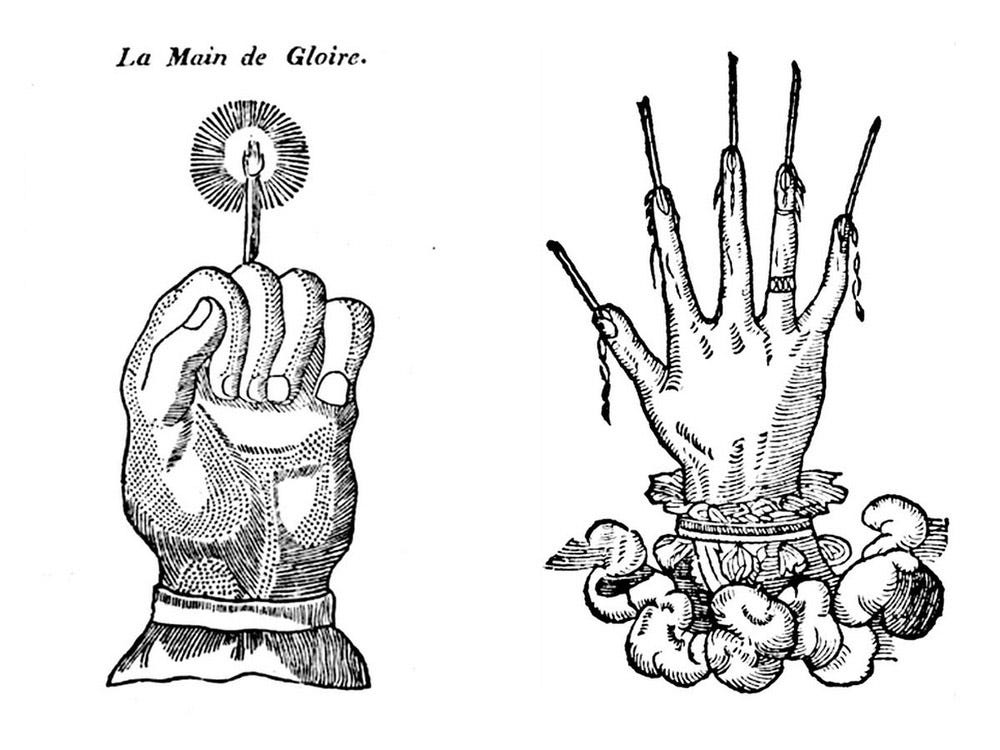
In this story, Cisco is borrowing from a bit of old European folk magic. A Hand of Glory is the pickled appendage of a hanged man, cut off while the man is still hanging. It is common to take the left hand of most criminals, but the right of murderers, for it is that hand which is assumed to have been the one to “do the deed”. A variety of powers are attributed to these totems which were made to serve either as candles or candle holders, and in this new form they would continue their afterlife of crime, as the Hand of Glory was commonly a magical tool of thieves.
An Incomplete List of Some of the Hand of Glory’s Abilities:
As long as the Hand’s candle is burning, those in the house being burgled will be held in a sort of coma, or deep sleep.
The Hand’s candle casts light only for its holder.
A veil of darkness will be cast upon any waking person in the Hand’s vicinity, other than the holder.
Any lock will open to the holder while the Hand’s candle is lit.
The Hand’s candle can burn forever.
Of course, to simply find a Hand of Glory, or even to use one, would be more in line with a gothic tale. Cisco’s piece must act not only as a servable bit of weird fiction, but it must also generate the magical charge needed to provide the egregore with a hand, so it is only right that the Hand of Glory replaces the narrator’s natural extremity:
“My left hand had come off by itself, during the night, and floated down towards the foot of the bed…I went directly to the box, opened it, pulled out my hand of glory…and I pressed the severed end of the ragged, leathery wrist to the numb and raw stump of my left arm” (45-46).
The suturing of this Hand of Glory to the body of the narrator endows him with many of the powers associated with the artifact, but rather than using it for simple thievery, he says he wants to steal back “all those stolen moments wasted trudging through one weary day after another” (50).
By believing in the Hand, I have been blessed by its candlelight, and this light has awoken me to the truth. I see how Hekla’s ill-fated journey was initiated by a similar desire to escape ennui. The leg did not disclose its information about the monster until the captain complained of being bored, of the monotony of floating through space all day. That, diary, gives me hope. I have attached my devotion to the enemy of suffocating boredom, and is not the very air of the Black Iron Prison an ambient monotony, a slow and constant choking, ever present even apart from its more acute punishments?
The Hand’s light has stirred me. No longer can I fail to see “who is awake and who is asleep”, and like Cisco’s narrator, I too am shocked to realize how many sleepers there are, “and how many of those who pretend to the great wisdom are not only themselves sleepers, but among the most deeply asleep” (52). But I cannot hold them solely accountable. It is this infernal prison air, the tainted tallow light which is all there is to see by in such a dungeon as ours.
As is written in the scriptures, in the Book of Melville:
“To-morrow, in the natural sun, the skies will be bright; those who glared like devils in the forking flames, the morn will show in far other, at least gentler, relief; the glorious, golden, glad sun, the only true lamp—all others but liars!” (481).
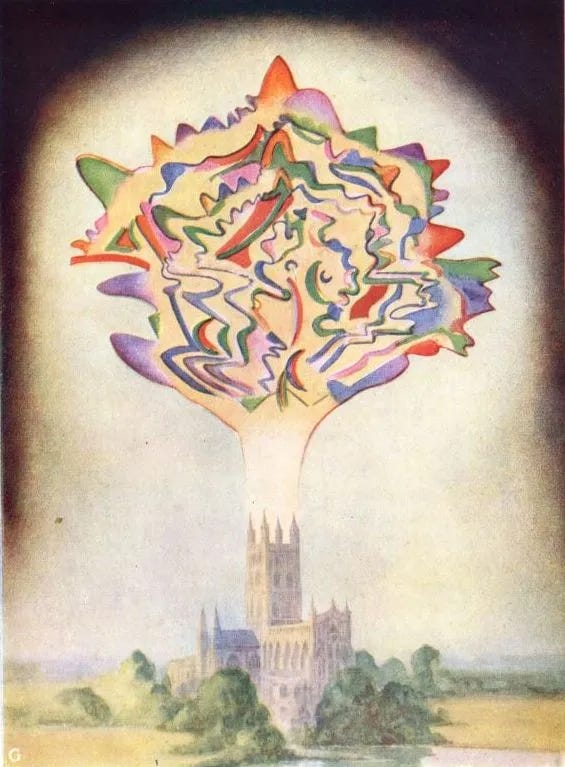
Then what is this Hand of Glory’s light, but a small flame of the true light? A captured bit of the sun, shining down here in hell? This egregore, then, our Prometheus, has brought us the light of the gods. May its Glorious light blind the archons, our wardens! These magnificent conjurers have located the enemy, and they have shaped their creation into the only thing it fears: a being of metal-breaking light, charged by the vast battery of our collective power!
I cast my sprinkle of devotion into the great vats already gathered. May our will guide thee, oh Giant. Break open the wrought iron ceiling encasing us, let us fill our lungs with great gulps of that uncorrupted air, and see each other, for the first time, in the true light of Day!
[Exit Music]
re: limb motifs and "...Miéville and Ligotti, VanderMeer, Barron, and Link..."
There's a Laird Barron story called 'Hand of Glory', which naturally features one, in 'The Beautiful Thing That Awaits Us All'. However it's a pulpy shoot 'em up that doesn't seem to have much in common with 'My Hand of Glory', which admittedly, I haven't read.
However, there's also a Cat Rambo/VanderMeer collaboration ('The Surgeon's Tale') having to do with a reanimated arm that seems more in line with 'Leg' and Cisco's story. All three invoke the numinous in the form of a severed limb that winds up attached to our narrator. That one shows up in collections from both authors ('The Third Bear'/'The Surgeon's Tale and Other Stories') and can be found in an archived Subterranean Press page online. If you're interested, there's a link to it on Rambo's Wikipedia page.
I'll close this out with my favorite bit of Hand of Glory Lore. 'The Encyclopedia of Superstitions' by E & MA Radford recounts a couple of stories (Collected initially by William Henderson) which suggest that the only way to extinguish the candle is not with "beer-dregs" or blowing them out, but by dousing them with milk.
Just finished my fifth cisco novel, definitley need to get around to reading his short stories sometime!