
Peasant Planet: Then, Now, Forever
On Richard Dawson's Trilogy for All Time (Peasant/2020/The Ruby Cord)

“We’re in 1320. You are a serf. Bitch, you live in Alsace. You are a peasant. You need to give your fuckin’ lord the grain,” such begins Brace Belden’s most memorable True Anon rant, as poignant now as it was when he first delivered it during high quarantine. It is a rally cry for class consciousness, a rousing to wake up to our rather desperate situation:
“Motherfucker, you gotta recognize where you are, and then you gotta get past that. You gotta be unemotional. You can’t sink into this hole. You live in the oubliette. Your job is to crawl up the ladder, motherfucker. You live in the HOLE. You’re in the HOLE. You are a RAT. And the rat, when he’s in the hole gets fucked. People only throw trash in the hole.
You need to eat a body. And you need to carry the plague. And you need to carry a plague around this whole world, that will change this whole fuckin’ world. And all your enemies will vomit black bile and will choke on blood and will grow boils and die. But only if you get together with your other RATS. And you come up with some kind of super plague, to fuckin’ end your enemies and—
End. This. Nightmare.”
I am sorry to report that in the six succeeding years, we have not ended this nightmare. In fact, the nightmare has only deepened. If you are reading this in the year 2026, I don’t think I need to go too much into the weeds here to flesh out what I mean by this.
People have been throwing around the phrase the New Dark Ages, and it’s no real surprise why. Still reeling from a global pandemic that was never, and probably never will be, adequately addressed, a rash of tyrants, mass paranoia, and an economic future our tech overlords are increasingly pushing towards serfdom, a renewed interest in the so-called Dark Ages only makes sense.
Speaking of our tech overlords—you may know Alex Karp as that geeked out old guy who went viral a couple months back and said that Mexican nationals should “wake up scared and go to sleep scared”. I am sorry to say he is the CEO of Palantir. Palantir, if you have not heard, is a tech company who, among other things, provides mass surveillance for the government. Their AI powered data-analysis is used both by ICE and Israel to track and target individuals.
Recently, Karp complained in his book that American arms manufacturers are constrained by too many ethical constraints. He really is speedrunning his way to the inner circle of most-hated billionaires. Still, he has done one useful thing. His recent comments about AI making us all work like peasants pulled taut in my mind the lines connecting the trilogy of albums by British avant-folk musician, Richard Dawson. An evil tech company producing the tools to bring us into darkness of future’s past: that’s all the ingredients for his Trilogy for All Time.
Readers of the music and culture mag, The Quietus, will be familiar with the publication’s golden boy, but, in case you are not, Richard Dawson is a musician from Newcastle. I have used the descriptor ‘avant folk’, but take your pick. His genre of choice might equally be described as freak or experimental folk, at least those are the labels other reviewers have attempted to peg him with. In a now 12-year old interview with The Guardian, Dawson says the term he prefers is “ritual community music”, and he probably is too nebulous for any prescription more specific than that. His career spans nearly twenty years and he seems to reinvent his style with each release1. Even the albums making up this loose trilogy vary wildly, but the message remains consistent:
“There has to be more than this.”
Then
Released in 2017, Peasant ushers in the trilogy with a mighty ‘Herald’ of brass that builds majestically for two minutes before breaking down into a series of disquieting fart jokes. Mood set, we move immediately into ‘Ogre’ which situates us, as if with a camera fading in from above, in a small village in the old Anglo-Saxon kingdom of Bryneich, in the vicinity of modern day Newcastle, where we will be staying for the next two thousand or so years:
“A dice of houses cast with clay and sheepdung
Through a soup of starlit peatsmoke
Gradually emerges as we descend.”
Bryneich, or Bernicia, spanned the region of northern England and southern Scotland back in the post-Roman power vacuum of the 7th century. Little is known about the area during this period. Even the origin of its name is less than sure, although best guesses have it derived from a Celtic word meaning “the Land of the Mountain Passes”. This lack of known facts gives Dawson freedom to sketch out a whole world here. He uses touchstones from our shared storehouse of medieval imagery, both historical and fantastical, but he has little interest in the high fantasist’s knights, kings, or royal courts. Instead, the stories pool in the lowest levels, around beggars, paranoid villagers, and in the anarchic zones beyond the king’s reach.
Around the same time this album was released, Oisín Fagan’s brilliant debut novel, Nobber, came out. It is another work set in the Medieval Islands of the North Atlantic, but this time over in Ireland in the summer of 1348. The bubonic plague has swept through the country, killing many, scattering leadership, and generally confusing the known order of things. It feels like a literary extension of the universe Dawson is creating and I often think of Nobber and Peasant as a pair2.
During times of upheaval, faith in the status quo weakens, and people become more open to radical change. However, as so often happens, rather than seizing the opportunity and striving towards a common good, a despot moves in. The town of Nobber falls into chaos, and is eventually beseeched by conmen.
Arriving just in time to witness a mob of townsfolk commit a murder, the conman then uses his witness as blackmail to take control. Thanks to the chaos of the moment and the collapse of the old status quo, there is no structure to resist him, and he is able to take over the town quite easily. With the aid of plague-necessitated quarantine, he uses blackmail, fear-mongering, and threat of violence to propel himself to a place of ultimate power. With the villagers trapped inside their houses, Fagan holds us to bear witness to a sick town losing its collective mind3. Confusion, dead bodies, and rot seem to crowd every home while a mysterious and maddening knock sounds at every door.
Chaos reins.
Fagan’s novel shares its claustrophobic and paranoid atmosphere with Peasant, but both the book and the album remain shot through with hope. While Dawson uses sudden lifts in mood, Fagan intermixes a deadpan humor into the intimate confusion, often to stomach-churning results. Despite the dreadful circumstances, the thing that flutters just off the page, never fully gone, yet always just out of reach, is Pandora’s dingleberry, hope:
“The lands are emptied out now and there are too few peasants to till the earth, but still their only wish is that their wages be raised. They could, in this confusion, or any of the ones that so often beset us, seize the country, reign it eternally, make it in their own lowly image, but even their dreams are limited by coin. Even they are trapped within its dreams, they who gain nothing by allegiance to it.”
Such is the curse upon Dawson’s own characters. They may never relinquish their hope, but it is rarely a collective hope, centering, more often, upon getting through another day, or escaping some immediate circumstance. Dawson doesn’t belittle these characters though. They are products of their milieu and he treats them with great tenderness and respect. Each song on Peasant is titled for a different medieval archetype: Soldier, Weaver, Beggar, etc, but he is not content to stick with the familiar; instead these archetypes are exploded into specifics through a genius of oblique lyricism that one sees compared to no one so often as Joanna Newsom4:
“Leaving the path lured by an emerald
I wander into the Bog of Names
Now I'm stuck fast
Calves sorry henges
Glued with the silence of newts in the gloaming
My leather flask froze to my hand
Globelets of wine rubies on my chin.”
These are the kind of lyrics that sound anything but lyrical when read on the page. Like Newsom, Dawson eschews the easy rhyme, forcing his Geordie tongue to find some other way to alchemize beauty out of the dense syllables, but this is not just him showing off his writing chops. It is this careful attention to the microcosm that creates the macrocosm5 and, after a few listens, one begins to feel themselves fully transported to this distant backwater of the Dark Ages.
Like the temporal games Pynchon plays in Gravity’s Rainbow when he maps post-war Europe onto the United States of the 1960s, Dawson draws on the old paranoia and daily struggle of the medieval subject until it slips over our own day and age like a thin veil. As this most recent tranche of Epstein files has revealed, the complete and utter rot our system is built upon would make the most decadent of medieval courts blush.
Backlit by those horrors, the track ‘Prostitute’ has become a standout on recent listens. As you may have already guessed, it tells the tale of a prostitute, a young woman who is sold into a life of sex work after her father dies.
“How is it so
A child can be bought for a year's worth of grain?
In this day and age
It's hard to explain but it happens again and again.”
Power vacuums like the one in Bernicia create the perfect conditions for this situation. With no institutional powers in place, the social safety net is nonexistent. Naomi Klein covers this quite thoroughly in The Shock Doctrine. When Neoliberalism destabilizes nations to do their societal looting, the effects are most felt by the people living there.
Rina Lu explores this in relation to the post-collapse years in Russia:
Homelessness was virtually nonexistent in the Soviet Union, but in the 1990s, it became a widespread crisis. The number of homeless children surged to levels not seen since the post-war years, when many were orphaned during the Great Patriotic War. By the 1990s, this figure had skyrocketed, reaching approximately 2 million.
Under these economic conditions, prostitution proliferated. The fall of the Soviet Union proved a bonanza to the oligarch class, both here in the west and in Russia, and it is far from an anomaly. It is a recognized pattern that neoliberalism both creates and takes advantage of. Many of the Russian and Eastern European women who tried to escape their circumstances by following ‘modeling’ careers west, only found themselves enmeshed in the web of Epstein. For the titular character of the song, however, there is one major difference: namely that this is the seventh century and the map is less set. Hope persists beyond the horizon.
The song opens with the woman asking “Is there no reason for me to exist, but for as a plaything of miscreants, malingerers, dastards and knaves?”, but it takes a turn when the narrator’s client “choke[s] to death on a dummy of puke” and she is able to seize this opportunity to steal his horse. Dawson ends on a chill-inducing note of triumph as she rides out of this “country of demons made flesh,” towards some unknown border.
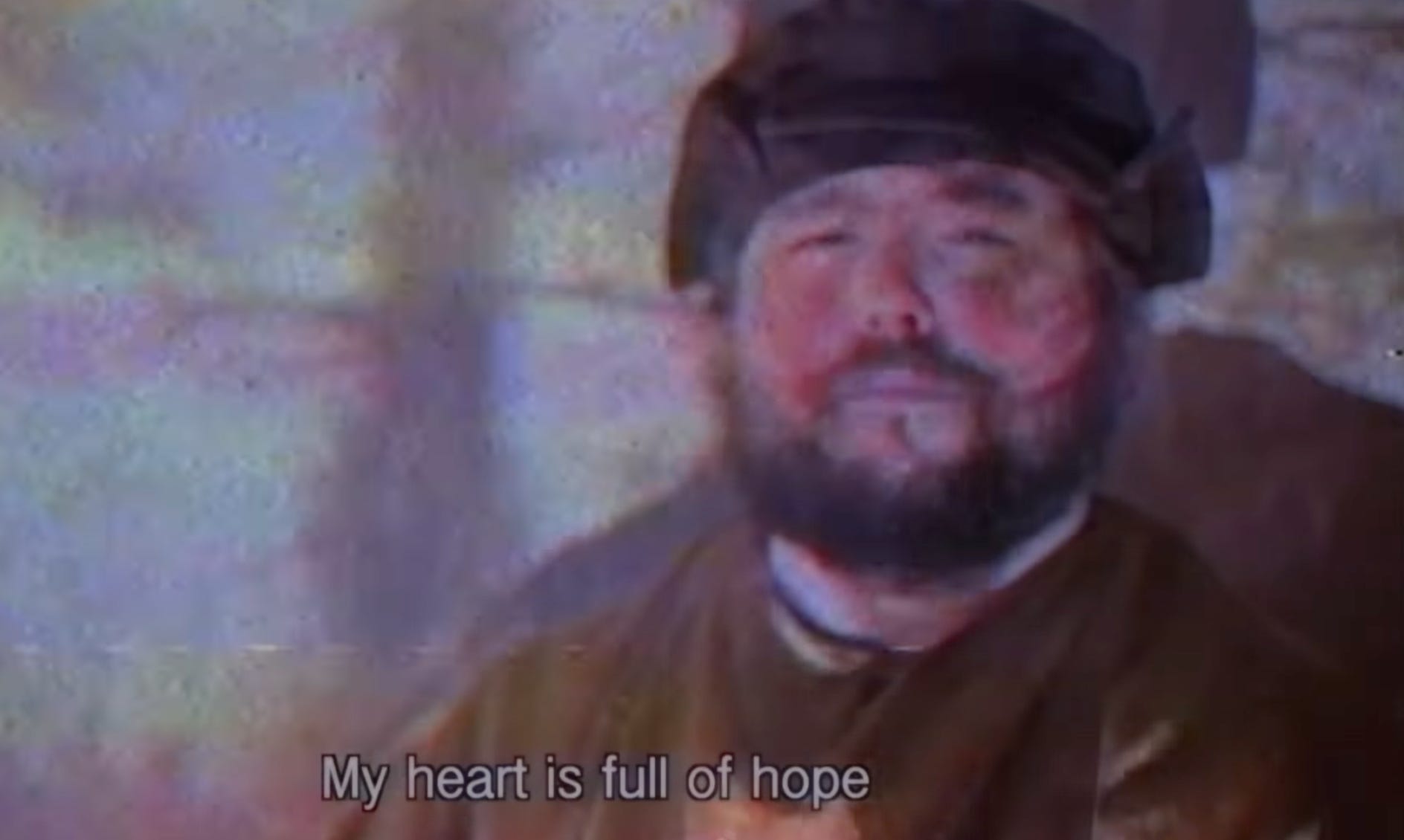
‘Prostitute’ is not alone on the album in her hope to find a better life some place else. ‘Soldier’ hopes for the same. On the eave of battle, his heart is full of dread, as the refrain goes. It’s only the thought of returning home, marrying his love, and finding some better place where they might raise a family that keeps him going. In thinking of that, the final repetition of the refrain changes to “My heart is full of hope”. It is one of the high points of the album and marks out one of the most important through lines in the trilogy: the dichotomy of hope and dread. While dread may be the primary feeling here (in fact Dominic Angelella refers to Dawson as the Poet Laureate of British Dread) overlaying the trilogy like a heavy blanket, hope continues to poke its nose through.
Like Prostitute, Soldier’s hope is born of the more liminal era in which the album is set. The borders aren’t so hard drawn. In the wake of the Roman occupation, things have not yet settled. If danger persists, so does magic. There are ogres and seers and shapeshifters, and it still seems possible that some better life might actually lay a horse ride away. In our collective imagination, this is the era of Happily Ever After, but what happens when the place you already are becomes that better place others are escaping to?
Now
With Peasant, I focused primarily on the lyrical content, largely because if I were to talk too much about the music I’d quickly be out of my depth, but I must say something here because the sonic qualities of these albums are equally as important to the mood and there is a major shift between each. Here, with 2020, we leave behind the acoustic strings and backing chorus of Peasant for something much more modern, heavy, and fragmented, befitting of its setting in modern day Newcastle.
Released in 2019, 2020 has proven a bit prophetic. While it might not have been particularly difficult to diagnose that things were going rather poorly in jolly old England at the time, that 2020 would become shorthand for how truly off the rails we have gone was impossible to know. Until then, those particularly privileged citizens of the West might still have managed to convince themselves that this was all somehow for them; that the rest of the world was there merely to act as mine, refinery, and storehouse for all their needs, but that illusion was becoming harder to maintain without some real high wire mental gymnastics. Neoliberalism’s shock doctrine had come home and the social safety net was becoming threadbare.
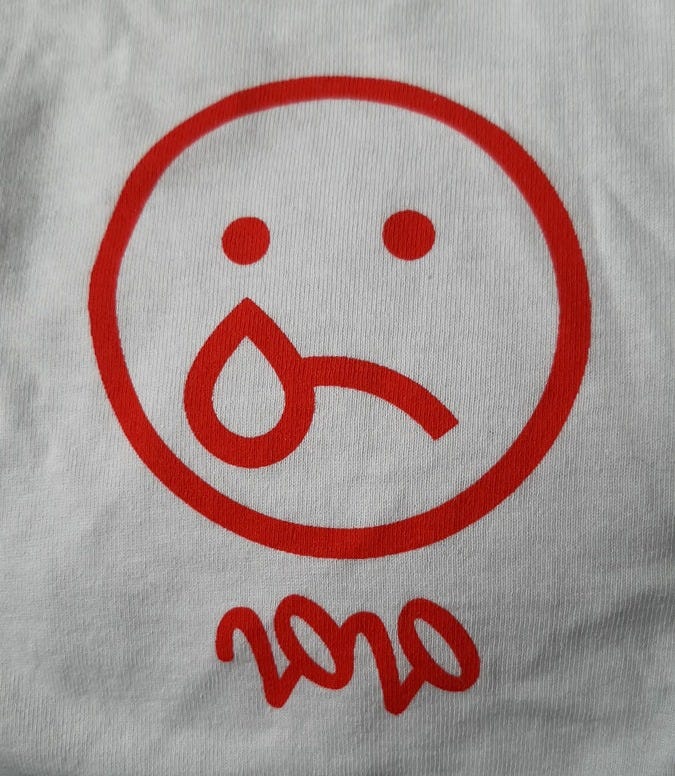
In 2020, the hope that Soldier and Prostitute clung to has in many ways diminished. The world is now fully mapped. There are no more mysteries beyond the horizon. The ebbing tide hides no ogres. People are simply trapped and stewing. This had been the case already, but quarantine went and made it quite literal.
At the same time, the total opposite is true. In an essay about Tolkien, Gene Wolfe wrote that in “one very real sense…the Dark Ages were the brightest of times… [because] they were times of defined and definite duties and freedoms.” There may not be much hope of escaping the role you were born into, but at least you are assured a role. For that reason, each track on Peasant is titled after one of these definite positions, none of them particularly enviable, but there you go. In 2020, such is far from a guarantee, so there does remain a kind of liminality, but it has soured into a sort of invisibility beneath society rather than beyond it. Danger of falling into this zone is the stick that propels the whole thing forward. What Karp seems to be saying about everyone working like peasants is that society has become a game of musical chairs and the number of seats are dwindling. If you find yourself left standing at the end of the song, there will be no recourse for you. Down in the hole with the rats you go.
For that reason, the songs on 2020 are named less after specific societal roles than situations. The only two tracks that are explicitly about particular roles are both about workers who loathe their jobs: ‘Civil Servant’ and ‘Fulfillment Center’.
I was working in a warehouse myself when this album dropped and I used to listen to the ten minute ‘Fulfillment Center’ on repeat as I made my drive to and from work. It was the most miserable job I have ever had. Ten to twelve hour shifts toiling away in an invisible warehouse just off the highway, all with a wrist-mounted computer that tracked our pace, making sure we remained up to the company’s par. I woke up each morning feeling as if I’d been run over by a truck, and that grueling monotony took every bit as much of a mental toll. There would sometimes be tears in my eyes by the time I pulled into the parking lot and listened to the outro one final time before bracing myself for the day:
“There's more, there has to be
More to life than killing yourself to survive
One day, I'm going to run my own cafe
Ahh-ahh-ahh-ahh, ahh-ahh-ahh-ahh.”
This line echos one from ‘Prostitute’, but here there is no chance to escape. My managers could have all choked on dummies of puke, but there would still be no border I could have turned and driven my pallet truck towards, no better country to raise up a family in. They simply would have been replaced by the company and we’d move on. The best one can hope for is to work on their own terms, ie run their own cafe. Dawson taps directly into this feeling of helpless misery that appears ever on the brink of boiling over into action, but never quite to any effect.
It is present in Fulfillment Center—
“A gentleman who spoke little English
Started to scream at the top of his lungs
No one could understand what he was getting at
Everyone stared ahead and kept working until
Someone came from on high to escort him from the building.”
—as well as in the opener, ‘Civil Servant’, which is something like the white collar version of ‘Fulfillment Center’:
“I don’t want to go into work this morning
I don’t think I can deal with the wrath of the general public
And I don’t have the heart to explain to another poor soul
Why it is their Disability Living Allowance will be stopping shortly.”
It’s one of the most universal feelings in contemporary society. Practically everyone I know, whatever their political leaning, hates their job, and yet on we go clocking in and out, spending the majority of our waking hours laboring away for the benefit of someone further up the ladder, totally alienated from ourselves and our fellow humans, meanwhile that resentment just eats away our interior.
I don’t think I will ever forget the feeling I had after my first shift. I was sixteen and had just been hired as a dishwasher at a fast food taco shop. By the end, I was soaked in dish water, reeking of lard, and probably on the verge of dehydration6. The next day was Saturday, no school, which meant I could work the lunch shift. My second shift began in just twelve hours. My life no longer felt like it belonged to me. It was no longer this long, flowing, free expanse of possibility, but instead it was chopped up, punctuated by work into these short gasps of free time. It was a true existential horror I felt, but I didn’t know how to voice it. When my dad asked how my first day went, I tried to tell him, but, if I was expecting sympathy, I got none. He’d been broken upon the wheel of his own twenty-plus years of commuting to an insurance job he hated.
A similar lack of solidarity haunts 2020. Many of the struggles are totally insular and could be solved by an honest conversation that will never happen. Rather than an ogre besieging a town, Dawson kneads in modernity’s more ambient anxieties, such as the stress to perform well that a child feels during a soccer game (‘Two Halves’), the melancholy of empty-nesters (‘Fresher’s Ball’), the fear that a partner is cheating (‘Heart Emoji’), and the unmoored paranoia of a life lived online (‘Jogging’).
These may be rather mundane, everyday realities7, many of them playing out totally in the psyche, but Dawson weaves this heavy feeling of dread that elevates each to a song-worthy Event, an archetype in itself, and he does all this as if a character from within the sung-about universe, someone who foresees the vibeshift several years before it was given an official name:
“I know I must be paranoid
I feel the atmosphere
round here is growing nastier
People don’t smile anymore.”
So if this is meant to be the good place on the other side of the border that others are risking everything to reach, there must be some reason why it feels like such utter shit. As we see in rather stark reality today, it has become those crossing the borders in hopes of finding a better life, rather than the vampires at the top of the system who have pilfered up everything for themselves, who bare the brunt of the blame for the bottoming out of society. Dawson does not shy away from this. While he writes his characters with pathos, a lot of them are still total wankers. In ‘The Queen’s Head’, “the fat-headed butcher” blames a flood on immigrants, and in ‘Jogging’ a Kurdish family has a brick put through their window; the police know who did this, but still they do nothing.
The peasants might be angry, but they have no access to the king or anyone in charge, and they are terrified of falling through the floor to even worse conditions, so they are more than willing to step on the heads of those beneath them to keep their own above water.
We are rats in a hole.
Forever
The Ruby Cord stands at the end of this cycle as both a sort of dystopian future that this trajectory leads to, and a further layering of life as it is right now. It picks up five hundred years after 2020. We are delivered into this distant future by a forty-one minute intro (‘The Hermit’) which itself contains a quiet, minimalist eleven and a half minute instrumental before the first lyric. It feels, if you surrender yourself to it, as if you are being carried to this very distant place, but it is something of a demanding album. In a way, it is a call back to Dawson’s earlier career, a reminder that Peasant and 2020 are Dawson at his most accessible. The Ruby Cord is sonically more similar to Peasant than 2020, but it is stripped down and much slower, making it feel far more remote and alien than its predecessors. Fitting for its role, but not an album to simply throw on after a long day.
While Peasant and 2020 situate us quite concretely in a time and place, The Ruby Cord is unstuck. Is it future? Is it past? The opening imagery is rather medieval, and if you thought we were going deep into the microcosmic with Peasant, oh buddy.
Alexa, zoom in on that leaf through which the sun is shining. Enhance.
“Vaporous shafts of a burgeoning sun
skewer the forest-floor onto a world fresh begun
all in the Name of the Harvest,
i.e. our ever-onrushing plasma.Shadows of leaves
mottled by the cleaves
of caterpillar’s ardent mandibles
form a basketweave of glowing mud,
bluebells in bud.”
Such pastoral lyrics make up the vast majority of ‘The Hermit’ as our titular character walks through this landscape apparently void of humanity’s encroachment, naming flora and revealing some of his past, but then “a storm of info [breaks] across [his] retina,” giving The Hermit the ability to access deep data banks about every lifeform around him. It is a shock as the listener realizes this character is a cyborg or at least technologically augmented in unknown ways, but then The Hermit lulls us back into his spell by using his new ability to return to examining the surrounding plant life. The song ends when a robot suddenly appears, or seems to. Upon “higher magnification”, it turns out to be a man dressed as a knight of old, “submerged at the waist in unyielding concrete.”
And what can the poor listener ask, but where the hell are we?
By the onset of The Ruby Cord, society has properly collapsed, but its technology remains strewn across the landscape. If I think of Peasant in tandem with Nobber, than The Ruby Cord might be an optimist’s prequel to Ursula K. Le Guin’s Always Coming Home which also takes place in a distant post-collapse future, and features an odd mix of the futuristic and the archaic, but in Le Guin we see a new society that has reorganized its relationship to technology in a healthy way. With Ruby Cord, we have not yet reached that time. Rather than a loving community, the album is spotted with individuals, or ‘Hermits’, who must make use of the available technology in their new desolation, or else it will continue to make use of them.
In ‘Thicker Than Water’, we follow a narrator whose family is locked within some virtual reality Matrix. He rips off their goggles and destroys the screens, but to no avail. Nothing changes. They are gone. He then flees down the abandoned highway system, “once the rumbling arteries of a great city,” now showing no sign of life, without purpose or direction.
It is a rather ambiguous song because Dawson is not simply spamming the touch grass meme. If his message is pro-luddite, it is only in the sense that Pynchon meant it in Is It OK to be a Luddite?, not a blanket rejection of technology, but an insistence to not let it become more than a tool, a prescient message as AI threatens to displace countless human roles. If our economic situation was differently calibrated, this might be a cause for celebration, a liberation from work, but instead it is an ushering of unprecedented numbers into that shadow zone beneath society.
That is where the suspicion of technology we see in ‘The Tip of an Arrow’ comes from. A father, named Temperance might I add, making for the third reference to a major arcana on this album8, tries to teach his daughter about the importance of doing things by hand, and not always resorting to the retina-display access to the internet that has been laced into their bodies:
“That in a world such as today’s
Where each person can display a bounty of data
On the quivering cave wall of their eyeball at the merest flick of a lash
The only facts of any worth are not so easily dispersed
Yes, it matters how we learn
Real knowledge must be earned
Everything else is a husk:
Wisdom’s simulacrum”
For philosopher Henri Bergson, there are two ways of knowing. The first, analysis, is the type of knowledge that an artificial intelligence might offer, a step-by-step guide, such as one might find on wikiHow or any number of YouTube tutorials. Certainly useful under the right conditions, but it is a knowledge from outside.
Intuition is a direct and intimate form of knowledge, the kind of second nature, or flow state, that one is able to enter into only after something has been baked into one’s being through repetition. This is the knowledge of the practiced musician or athlete. Think back to ‘Two Halves’, the track on 2020 where the kid cannot get out of his own head during the soccer game and winds up botching every chance he gets. He is outside the game. To truly play, one must lose themselves in it. The hunter must approach his prey in the same way. There is a sort of becoming-animal that is necessary.
It is this embodiedness that we have lost touch with by the time of 2020, and that is why prescribing exercise as a medicine actually does have some positive effect on the narrator of ‘Jogging’: an elemental medicine for an elemental disease, as Gaston Bachelard would say. Each time we gaze into our phone, we swim through a world of detached images. The various exhibits representing our own time in ‘Museum’ might be from an actual museum of the future, but it also works quite well as a metaphor for what one comes across on social media: “Scared young soldiers wielding guns/Shoppers idly flicking through clothes/Gently spinning astronauts/A classroom deep in thought/Throngs of cheering football fans/A doctor crying alone/Riot police beating climate protestors/Babies being born.”
The barrage of images one scrolls past are totally removed from context, and the carouseling effect of the scroll metabolizes each into an equilibrium of importance, adding false weight to the totally mundane, and robbing the actual weight from true horrors.
These three albums emit a call to remember that whatever abstractions history might consists of, backwards-flying angels or what-have-you, it is made up of individual human lives. That could maybe serve as the thesis for this trilogy which is at once epic in its scope, and touchingly intimate in its details. For all of our millennia of macroscale fuck ups, something keeps hope alive on the micro side, that is, in our daily lives. What is communicating to us from beyond this Black Iron Prison of our own creation? What is the source of this in-breaking hope that so consistently keeps afloat the dream of a better alternative in the midst of such dreadful circumstances?
Perhaps it is only that The Ruby Cord is set in the future and the future is unsure, indeed, it is “pregnant with an infinity of possibilities,” to return to Bergson again, but its characters are not as shackled as those in 2020. Once again, they have returned to a more liminal space of possibility, a zone. One cannot live in a zone, but it is only from such a place that the New can be born. Eventually, this must coalesce into something more stable, a new world in which we can dwell, but what that will be is never settled.
The final song of the trilogy, ‘Horse and Rider’, is an exit from the zone, towards a new, as-yet-unknown settled place. It might actually be a return to the end of ‘Prostitute’, but this time told from the horse’s point of view:
“Leaving behind a rose horizon, frozen in place
You lean forward in the saddle to embrace
I wonder if my lady knows there’s no way back
To the world from which she was born?
And that the only way out
Is forward and down?”
As always, Dawson jukes the listener. One might expect the only way out to be through, but instead he weaves to “forward and down”, which is a position used in horse training, but it is also the direction which creates a spiral. This, again, is reminiscent of Le Guin’s Always Coming Home, in which the spiral plays such an important role. The heyiya-if, a two-armed or hinged spiral, is the sacred symbol that lays at the center of the Kesh’s cosmology. For the Kesh, it is from this still center that everything emerges, but it is far from static. It is open. It breathes. It brings in and it lets go.
In ‘The Fool’, Dawson tells us that “love is older than the sun”. Typically we think of the sun as the source of all life. Not only for its light and energy, but because its gravitational pull is what spun all of this into being, but if love was here first then love must have spun the sun into being meaning it’s all spirals birthed in love, baby. Onward we go, spiraling. Over unseen churning seas, my fellow rats. Nothing is sure and we have no one but each other. Ahead, towards never ending passages through the cold and dark. Forward and down, my fellow rats, forward and down, ever towards the end of this nightmare. There is, there has to be, more to life than killing ourselves to survive.
[Exit Music]
spanning the spectrum from Hen Ogledd’s space glam on the album Free Humans to prog metal when he teams up with Circle to make Henki
If we wanted to make another trilogy, you could slide in Ben Wheatley’s film A Field in England (2013) with happy success.
It really is a great book. Like a medieval Eddington.
Although he cites his favorite songwriter as Nev Clay and vocally the closest analog is probably Robert Wyatt.
As below, so above.
That last one is on me. I was a shy kid and didn’t know where to get (potable) water.
He goes into some less common areas, such as falling into Chapel Perilous after witnessing a UFO, but if we crack into ‘Black Triangle’ this essay will never end.
Which I would also love to go into, but will refrain from doing here. If any body has a 33 and 1/3 connection, let your boy know.
As a great enthusiast of strange Irish fiction my unending thanks for introducing me to Nobber! Might I recommend Kevin Barry's City of Bohane which I feel night be up your alley!
I love Richard Dawson so much. I saw him in Manchester last year on the End of the Middle tour (which is, admittedly, my least favourite album of his) and he was so charming, it was such a warm-feeling gig.
I'd say him and Kiran Leonard (who is so absurdly unknown) are my two favourite British songwriters of the last ten years or so. But I am heavily biased towards things of a folksy indie-prog nature