
Profane Grail
On Ursula K. Le Guin's "The Lathe of Heaven"

“And pristine alphabets and cows that moo
And moo as they jump over moons as new
As that crisp cusp toward which you voyage now.
Hail and farewell. Hello, goodbye. O keeper
Of the profane grail, the dreaming skull.”
-from “The Ghost’s Leavetaking” by Sylvia Plath
One has to entertain the notion of some kind of outside intervention taking place at Berkeley High School in the late 1940s. Philip K. Dick graduated from there in 1947 and Ursula K. Le Guin followed just one grade behind. This was the same year the the CIA was taking shape out of its OSSified pupa, so we can probably rule out any MKUltra fuckery simply based on the timeline1, but if we rule out the CIA, then what does that leave? We are just meant to believe that a single California public school produced two of the most influential writers of their generation in back-to-back classes? Either the school had one hell of an English teacher, or it must have been constructed on a ley line. Otherwise, it seems quite the coincidence. The school just does that: produces sci-fi mystics of various traditions2?
If Phil Dick is Berkeley High’s Gnostic mystic, then Le Guin is its Taoist one, and somewhere out there in the moth-eaten slush piles of extinct pulp publishers, or forgotten upon the shelves of California’s second hand bookstores, are the works of Berkeley’s other sci-fi mystics, one working in the tradition of Kabbalah, another a Sufi, others Tantric or Yogic, and so on.
But we are focused here upon the Tao of Ursula. She wore her influence quite openly, going so far as to publish her own interpretation of the most famous Taoist text out there, the Tao Te Ching. In the introduction, she shares that it was a book that she grew up venerating. Her father, Alfred Kroeber, an anthropologist who studied under Franz Boas, kept an 1898 Paul Carus edition, “bound in yellow cloth stamped with blue and red Chinese designs and characters”, which he consulted often. Le Guin inherited the book after her father passed, and treasured it. Her work is steeped deeply in this Taoist influence, and her 1971 homage to schoolmate, Philip K. Dick, The Lathe of Heaven, is no exception.
A Little Bit of Exposition
The novel begins with a quote from Chuang Tse, more commonly spelt these days as Zhuang Zhou, probably the most influential Taoist after Lao Tzu, having authored the tradition’s second foundational text, Zhuangzi.
“Confucius and you are both dreams, and I who say you are dreams am a dream myself. This is a paradox. Tomorrow a wise man may explain it; that tomorrow will not be for ten thousand generations.”
This quote marks the first chapter. Each subsequent chapter is begun with its own quote, most of them pertaining to dreams in one way or another. While Tse is the source cited most often, Lao Tzu receives his fair share, as do a range of others, including HG Wells and Victor Hugo, who also offer insight on the topic of dreams, which is, of course, the focus of the book.
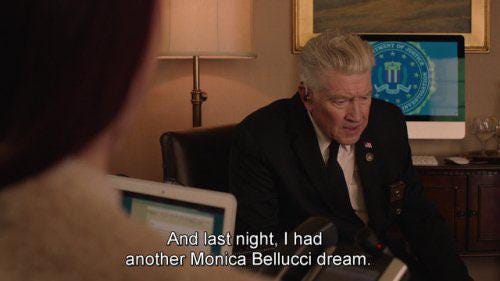
“We are like the dreamer who dreams then lives inside of the dreams” as Monica Bellucci says to Twin Peaks’ Gordon Cole, “but who is the dreamer?”
In the case of The Lathe of Heaven, the dreamer is George Orr.
Orr gets busted when he nearly overdoses on barbiturates and Dexedrine, which he was taking precisely to avoid dreaming. When the medic arrives to look him over, it is discovered his stash exceeds his personal allotment and that he had been borrowing pharmacy cards from others in order to get his hands on such a supply. In a great pastiche of a Dick world-building scene, Orr is given a choice: either spill the names of those whose cards he borrowed and be let off with some Voluntary Therapeutic Treatment, or refuse to do so and be stuck in the much scarier sounding Obligatory Therapy.
When Orr still refuses to give a name, Mannie, the elevator guard who’d found him and called up the medic, takes the fall, saying he’d lent Orr his pharm card, thereby lightening Orr’s punishment. Rather than being institutionalized, he is sent to Dr. William Haber through whom we learn why Orr is so afraid of dreaming.
At the risk of sounding insane, Orr confides in his self-professed oneirologist that he has had dreams that changed the non-dream world. It takes a while for Haber to understand what he means. It is not that his dreams are prophetic, but that they actually alter reality, and do so in a way that retroactively alters history. Say Orr were to have one of these dreams about the sky being green. He would not wake to a world where the population is freaking out over a suddenly changed sky. No, the world to which he awoke would have always had a green sky. No one would think a thing about it. Orr would be alone in remembering Old Blue.
We cannot say that his dreams transport Orr to a parallel universe rather than change this one because people can be made to remember the pre-dream reality, especially those who are present as Orr dreams, which is how Dr. Haber begins to believe his patient. He then quickly sets about putting these dreams to his own use.
Haber is not portrayed as an outright evil man. He does, of course, use Orr’s power to better his own station, but there is a lack of the dreadful Master of Reality type manipulation that is exhibited in something like Dick’s own The Three Stigmata of Palmer Eldritch. This is in part, perhaps, because Le Guin is simply not noided in the same vein as Dick, but also because Haber never actually becomes a master of reality. Dreams are much too slippery for that. While he slowly gains more and more control over Orr’s dreaming, he is never able to master the mechanism. Whatever changes he tries to implement upon the world manifest like a genie granting a wish:
“But he’s not a mad scientist…he’s a pretty sane one, or he was. It’s the chance of power that my dreams give him that twists him around. He keeps acting a part, and this gives him such an awfully big part to play. So that now he’s using even his science as a means, not an end. . . But his ends are good, aren’t they? He wants to improve life for humanity. Is that wrong?” (75).
These attempts at doing so go wrong in cheeky ways: When Haber tries to improve living conditions for the crowded and starving masses in the ecologically exhausted world, he ends up reducing the population by billions. When he attempts to end racism, everyone is turned grey. And when he tries to produce peace on Earth, aliens appear and war moves to space.
One can easily imagine Trickster grinning in the corner throughout the novel. If there is a universal mind, who says it has to be sane, indeed.
No King in Dream
Herein lies the crux of the novel: humanity as masters of the world vs. humanity as a part of the world. It is a theme Le Guin often returned to throughout her work, which always contained ecological concerns:
“We’re in the world, not against it. It doesn't work to try to stand outside things and run them that way. It just doesn't work, it goes against life. There is a way but you have to follow it. The world is, no matter how we think it ought to be. You have to be with it. You have to let it be” (140).
Now, perhaps such words could be twisted into some sort of defense of laissez faire capitalism, but such a reading could not be done in good faith. Despite laissez faire’s translation into let it happen, it is not at all a natural progression, for it requires a disqualifying prerequisite: the conversion of the world into a standing reserve. This flies totally in the face of Le Guin who constantly writes of the world as populated by non-human peoples, almost in an animistic way. Everything dreams, she writes. That is how the world renews itself:
“The play of form, of being, is the dreaming of substance. Rocks have their dreams, and the earth changes” (167).
These rock dreams may be unconscious3, but it is nonetheless the process that shaped the universe. Some matter dreamt of coalescing into a burning ball of gas, and the first star was born. Its gravity well, in turn, dreamt up planets whose tectonics dreamt of volcanos who beget islands, so that out of the sea land was born, and a fish to dream about living on that land, and so on until monkey dreams man.
When humanity came along, and a fully conscious mind began to dream, the game forever changed. As with Orr’s effective dreaming, the totally abstract could be conceptualized and acted upon in ways never before seen, like the famous scene in 2001: A Space Odyssey when the black monolith appears and the world’s first weapon is materialized out of Dream. Thus begins a chain reaction leading directly to space travel.
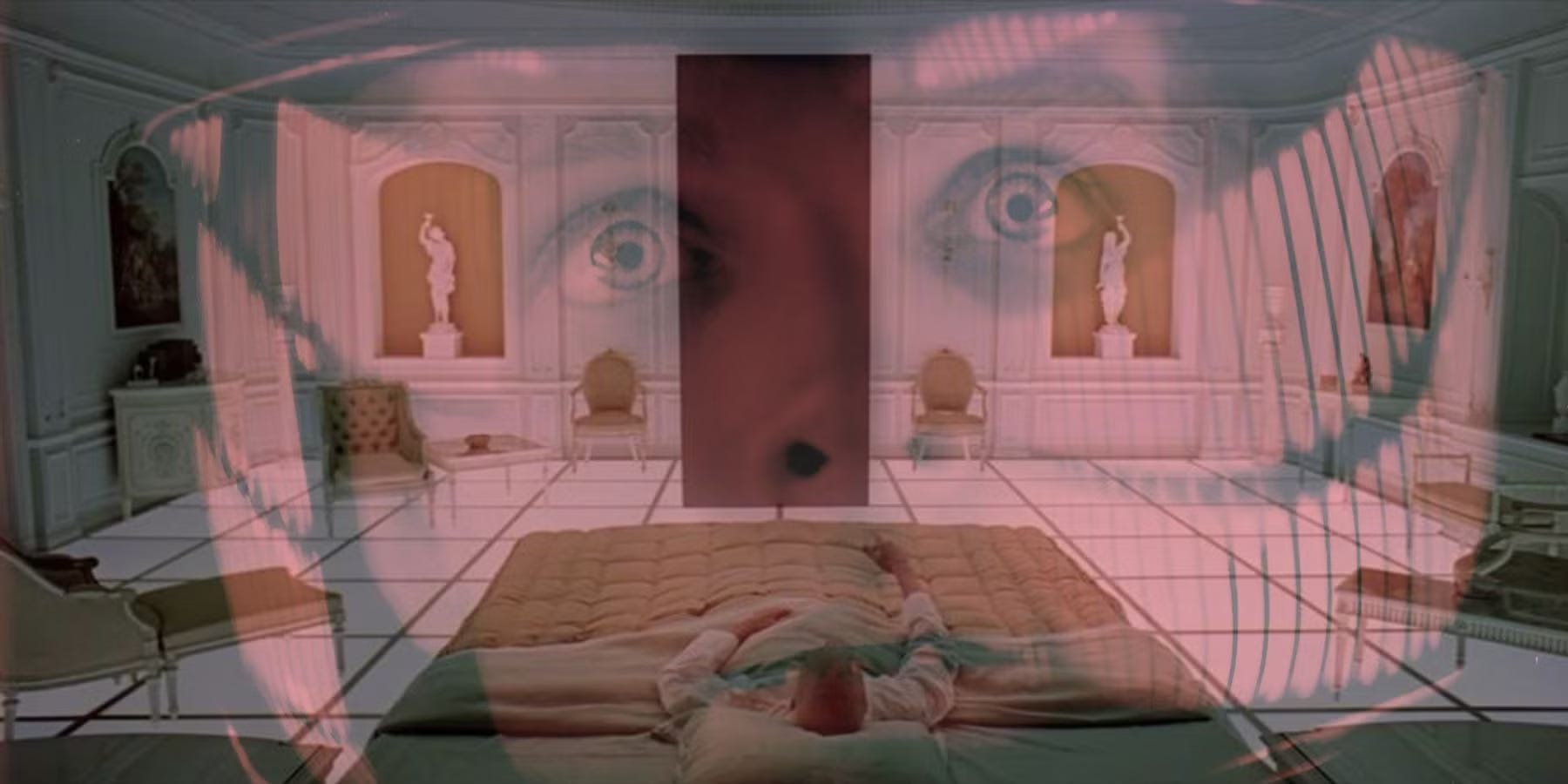
As Chapter 42 in the Tao Te Ching says,
“The Way bears one.
The one bears two.
The two bear three.
The three bear the ten thousand things.”
Dream created one out of zero, and shortly thereafter the world’s total web of interconnection had formed a system beyond quantification. The cacophony of pre-human dreams did not result in perfect harmony, but rather allowed for endless adjustments and counter adjustments, a vast cybernetics that kept things more or less operational for a numberless array of beings.
Humanity has proven to be the stick in the gear that has gummed up the celestial machine. A millennia of conscious dreaming for our own benefit has left the world in ecological ruin. Humanity has been attempting to live as if outside the world, treating the planet as a vast stockroom rather than a home, something that can be totally controlled and traded for our own enrichment, somehow forgetting it is the one inhabitable bubble in an infinite vacuum upon which we are totally and desperately reliant.
Haber aims to fix our situation from the same position that caused it, the outside. Before Haber took control of Orr’s dreaming, they were a rare event. It wasn’t every dream that changed reality, but only “effective dreams”. These occurred largely in times of great stress, such as in response to an abusive family member or a near death experience. It was a subconscious defense mechanism that guaranteed Orr’s survival, but through Haber’s use of technology effective dreaming becomes a miracle tool for reshaping the world to his own liking.
As opposed to adjusting ourselves to the available niche in the great mosaic, we are determined to sit atop everything else, dreamcasting ourselves into total control. The problem is the insidious idea that the world is raw material waiting to be improved and profited upon. There is no reverence for the Taoist ideal of uncut wood in itself, but only for the use it can be put towards, and the ends it can yield.
This brings us back to the question of who is the dreamer. When it is one part of the world’s vast mosaic who is forcing its dreams upon every other part, Progress spells disaster. The ancient dreaming of the landscape worked so well for so long because it was a collective dream. There were natural mechanisms that put limits on any one part’s ability to effect overwhelming change.
Human consciousness has meant the ability to short-circuit such limitations. It has meant that humanity’s dreams can overrule the dreams of everything else. We have forgotten the mosaic. We have forgotten, as Le Guin writes, that
“things don't have purposes, as if the universe were a machine, where every part has a useful function. What's the function of a galaxy? I don't know if our life has a purpose and I don't see that it matters. What does matter is that we're a part. Like a thread in a cloth or a grass-blade in a field. It is and we are. What we do is like wind blowing on the grass.”
Wu Wei
The aliens who are manifested out of Orr’s dreams are said to be of the dream time. It takes a few disastrous attempts, one or two destroyed worlds, before Haber-directed Orr is able to dream up a peaceful scenario, but eventually he does and the aliens come down to Earth. They seem to know about their origins. In this new reality, of course, they have a deep history, but in the meta-reality they are recent creations borne from Orr’s mind and for that reason they are naturally drawn to him.
Orr learns they, too, are effective dreamers, but they refer to it as iahklu. He asks an alien named Tiua’k Ennbe Ennbe to explain this to him. Ennbe, who hilariously enters the antique trade immediately after getting settled on Earth, struggles to put anything else about it into language. Instead, he offers Orr a copy of The Beatles’ With a Little Help From My Friends. This would seem to communicate a depth of appreciation for interdependence, and advise against changing the world according to the whims of one man (or one species), but rather to seek to align oneself with the world’s own rhythms.
This is reminiscent of the Taoist concept of wu wei. Wu wei is something like the way of water. It is sometimes translated as ‘non-action’, but might be more easily understood as ‘effortless action’. Think of water flowing down a creek bed. It goes where it may, moving through crevices, filling the low places, going around what it must, and pooling patiently when it cannot continue.
What might this mean for those of us who are not a stream?
Wu wei is not some esoteric art accessible only by Taoist monks. We each exhibit its qualities from day to day, most often when so immersed in an activity that we are not even thinking about it, like walking down the sidewalk. It is the most natural thing in the world until one starts to think about it. Then, how quickly we become self-conscious and prone to stumbling. Breathing, too. It just happens, as long as we don’t overthink it.
In this way, wu wei is the embodiment of an activity, performed without distraction or self-consciousness. As Ron Swanson says, “Don’t half ass two things. Whole ass one thing.” Take each thing as it comes while accepting it for what it is. Don’t try to make it otherwise. Lucky for us, our modern world gives us significant opportunity to Practice acceptance of our total inability to affect a given situation. Try to remember that next time you are stuck in traffic.
How else might wu wei manifest? In agriculture, this might mean planting according to conditions, like don’t grow kale in the summer or plant water-intensive cash crops in place of staple necessities, or force golf courses and green lawns out of the desert. Cut with the grain. Ride the current. Gardening becomes a hell of a lot less difficult when one plants natives. The benefits of doing so extend beyond the gardener, bleeding over to the entire mosaic by providing food and shelter for local fauna, by using an area-appropriate amount of water, and requiring less soil additives as these are plants attuned to the available conditions.
Le Guin embodies wu wei in the opening paragraphs by writing about a jellyfish moving through the water. She is not one who often hits the nas with her prose, electing, instead, to weave a subtle, enticing spell capable of working a hypnotic effect that is on special display here:
“Current-borne, wave-flung, tugged hugely by the whole might of ocean, the jellyfish drifts in the tidal abyss. The light shines through it, and the dark enters it. Borne, flung, tugged from anywhere to anywhere, for in the deep sea there is no compass but nearer and farther, higher and lower, the jellyfish hangs and sways, pulses move slight and quick within it, as the vast diurnal pulses beat in the moon-driven sea. Hanging, swaying, pulsing, the most vulnerable and insubstantial creature, it has for its defense the violence and power of the whole ocean, to which it has entrusted its being, its going, and its will” (1).
This jellyfish is likened to the dreaming mind. By the end of the third paragraph it has been cast onto dry sand, as we all are upon waking, in order to face the ready-made creation/Of chairs and bureaus and sleep-twisted sheets4. This waking mind and the dreaming mind are juxtaposed throughout the novel as the industrious attempt at total control, and the Taoist ideal of wu wei.
“You must learn the way. You must learn the skills, the art, the limits,” (167) Orr tells Haber after his exchange with Ennbe Ennbe. The world cannot be saved through a miracle act of sheer will, but only by retreating to our natural position. This does not mean sacrificing mind, but it does call for a change in perspective. We must come in from outside the world and rejoin our place within it. Unconscious mind of rock inherently knows the way, but humanity’s restless mind must remember it.
There is wisdom in the stones as there is in the ancient texts, but neither can be plainly spoken. Lao Tzu is quite explicit in writing that The Way cannot simply be told. Ennbe Ennbe, too, found himself at a loss for words, and instead offered a piece of art. I will follow the alien’s lead. The 51st chapter in Le Guin’s interpretation of the Tao Te Ching might serve quite well in closing us out here:
“Nature, nurture
The Way bears them;
power nurtures them;
their own being shapes them;
their own energy completes them.
And not one of the ten thousand things
fails to hold the Way sacred
or to obey its power.Their reverence for the Way
and obedience for its power
are unforced and always natural.
For the Way gives them life;
its power nourishes them,
mothers and feeds them,
completes and matures them,
looks after them, protects them.To have without possessing,
do without claiming,
lead without controlling:
this is mysterious power.”
[Exit Music]
Take it away, boys—
MKUltra officially began in 1953, but it certainly behooves one to take any official CIA story with a healthy pour of salt.
With middle names that start with the letter K.
Then again, they may not be. Who am I to say?
The Ghost’s Leavetaking by Sylvia Plath
You have the two K’s but don’t forget the all important middle “e” in Berkeley !
I’m reading Left Hand of Darkness and now plan to read this next.