
The Great American Beach Read
On Joy Williams' "Breaking & Entering"

The beach is not a happy place. It is with good reason that tourists, springbreakers, and resorters must ply themselves with such vast quantities of alcohol in order to hold themselves against its presence. They are vacationing at the edge of the world, in pure liminality, splashing about in the still-bleeding wound left by the moon’s exodus, building their hopes on a foundation of sand. No, the beach is not a happy place, but rather a stage for melancholic reflection. It is a production in which the immensity of the backdrop overawes the players; lines go unspoken as gazes are drawn away from the audience and towards the vast tidal suck and release.
The beach is not a happy place. Joy Williams understands this.
Her third novel, Breaking & Entering, takes place primarily in the Florida Keys, as well as some towns along the Gulf Coast. We follow young married couple, Willie and Liberty, as they break into the empty vacation homes strewn through this part of the world. While it is not made explicit, such empty decadence is what makes the vacuousness of the world in the novel so palpable. That people are allowed a gratuity so ridiculous as owning empty vacation homes in the Florida Keys is exactly what makes the world Willie and Liberty are traversing feel so empty and unreal.
The song I have chosen for this week’s [Exit Music], November Rain by Mount Eerie, is especially relevant and it might be worth transcribing its lyrics here because they really cut to the bone of the novel:
“I can see the lights of the unoccupied second homes
that they keep lit up for no reason
reflecting on the barely moving water
on an inland sea where people park their moneyI live year-round in a vacation place
I love the winter wind in my face
harrowing beneath trees this big and groaning
no echo loud enough above the blowingAll these absentee owners miss
the huge embrace, the pressing kiss
of this specific November rain in the long darkness
but that’s OK. I’ll drink all the rain while I trespassThey keep the outside light on though
I guess to let everyone else know
keep away, this patch of night sky I also claim as mine
but don’t they realize all our stolen wealth
is built on screaming bones?In their lights that dot the hillside
I see blinking eyes”
Willie and Liberty are not thieves. They are not out to steal back all those screaming bones. No, there is something creepier going on. A creepiness imbued in them from living in such a creepy society as one whose citizens want to claim a patch of night sky for themselves. It is something like “the thrill of wearing another man’s skin,” to quote Dennis Reynolds. Willie is into it. This thing they do. He likes to leave a pile of his hair in the center of the living room for the homeowners to find upon their return. Willie is what one might call a walking red flag, but fear not. Willie can go on his own way, for here we will be following Williams’ lead and taking for our focus Liberty and her dog, Clem, a white Alsatian who she found in a mailbox as a puppy. The dog has an arresting effect on people, much as the book seems to, and by this I do not only mean its contents, but its presentation.
I manage a failing coffee shop. It is kept alive by college students, but in the doldrums between semesters business reduces to a trickle. By midday, the rest of my team has long asked if they can dip. I stay behind to go down with the ship, manning the cafe alone through those empty afternoon hours for which the owner insists we need to stay open. During this time, I get a lot of reading done. I sit on my throne of milk crates behind the register with a book, putting it down every half hour or so when a customer walks in. Rarely is this commented upon, but with this book in particular almost everyone who caught a flash of the cover asked about it.
Despite the fact that I operate this here blog in which I write at great length about what I have been reading, I have never exactly excelled at answering the on-the-spot inquiry: “What’s that book about?”
“Oh, a couple in Florida who breaks into vacation homes,” I might say, adding rather vaguely, “it’s very strange and dreamy.”
All and all, a pretty poor description of one of my favorite novels, but almost without fail the inquirer appeared smitten. Several declared they’d be ordering themselves a copy, in which I encouraged them, even while doubting it was anything I said that had convinced them to do so.
No, it must have been the cover, and that’s not just me saying it.
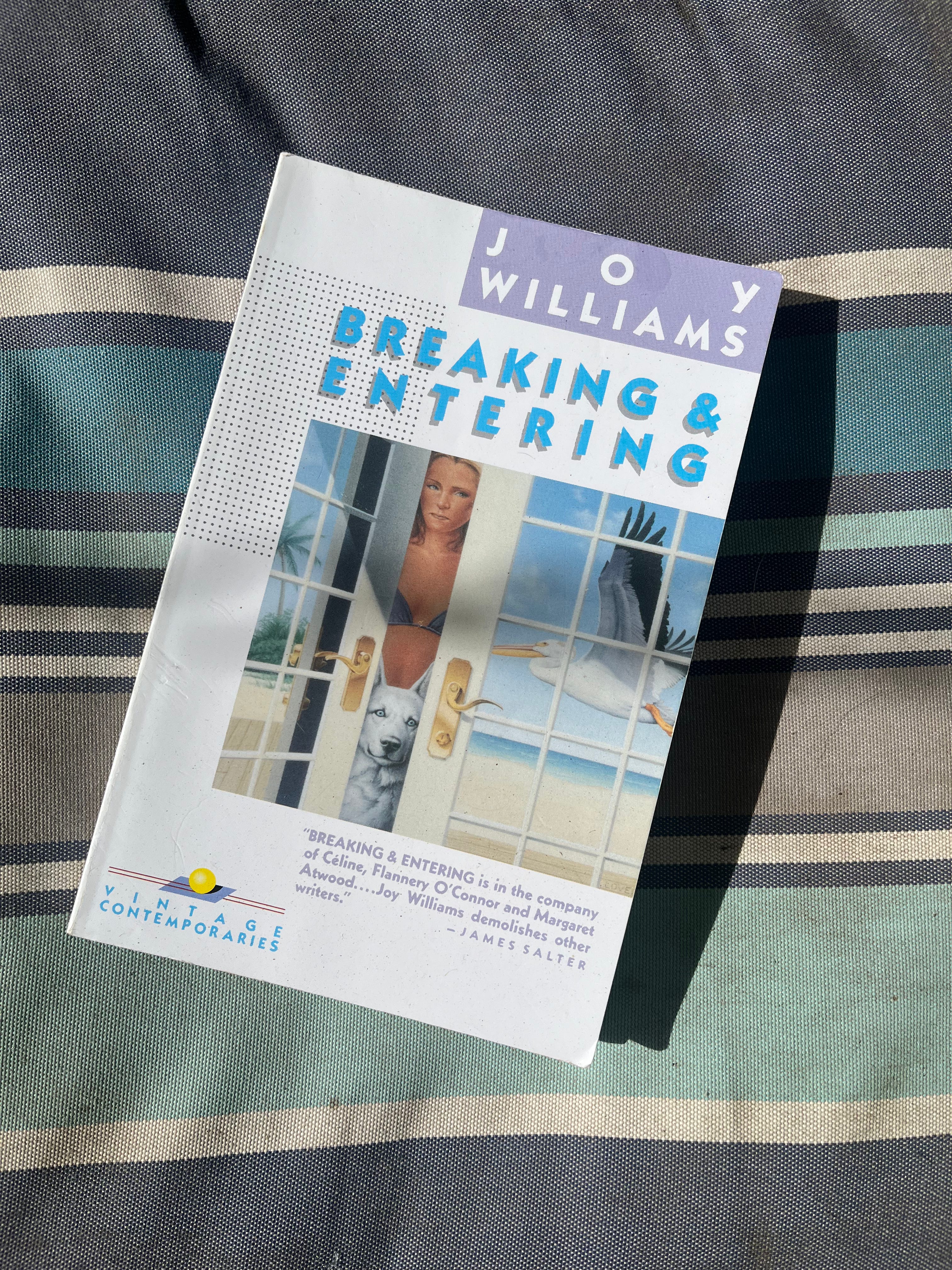
Evan Dent begins his review with a discussion of the cover as well:
“Let’s start with the cover. I know, I know, you’re not supposed to but: the cover. Book’s been out for 35 years and Joy Williams’ reputation has only grown and no one’s touched it. Why mess with perfection? The best Vintage Contemporaries cover in a crowded field of contenders. . . Microcosm of the entire book on there: woman, dog, beach, seagull, a general air of uneasiness. (Special shoutout to cover artist Rick Lovell: you didn’t have to go this hard. The repeating diagonal lines on the left side of the shadow on the door, Liberty’s swimsuit, and Clem’s ear?) It helped me connect with my wife-to-be. . . I hope after death that I open my eyes to this exact image, first thing, and then God (the dog, naturally) beckons me into the beach house of the afterlife.”
Whether or not Clem is God (certainly not ruling it out)1, he definitely has the same sort of magical effect on the characters within the novel as the cover does on those of us outside of it. On more than one occasion, Liberty is asked if she is willing to give him away, as well as whether or not he says his prayers, and the much more typical does he knows any tricks (he does not). She is told he is the color of the inside of Rothko’s forearm, that he displaces space so effortlessly, that he was recently seen in the remote jungle, that he and her elicit confessions— and that is how they should be taken, he and her, an irreducible pair, much like the two characters in La Force, or Strength2, the eighth or eleventh Major Arcanum of the Tarot depending on the deck in question.
La Force
Rider-Waite-Smith (and its endless variants) is the most popular deck today. Unless you have a more intimate relationship with Tarot, its images are probably the ones you are most familiar with, but the Marseille deck came first and placed La Force in the eleventh spot of the Major Arcana. Waite moved it to number eight, swapping it with Justice, “for reasons which satisfy myself”. Aleister Crowley kept the original placement for his Thoth deck, but assigned the Hebrew letters that would come with switching the cards, giving the arcanum a Schrödingerian vibe, a liminal bothness, like a wave-particle.
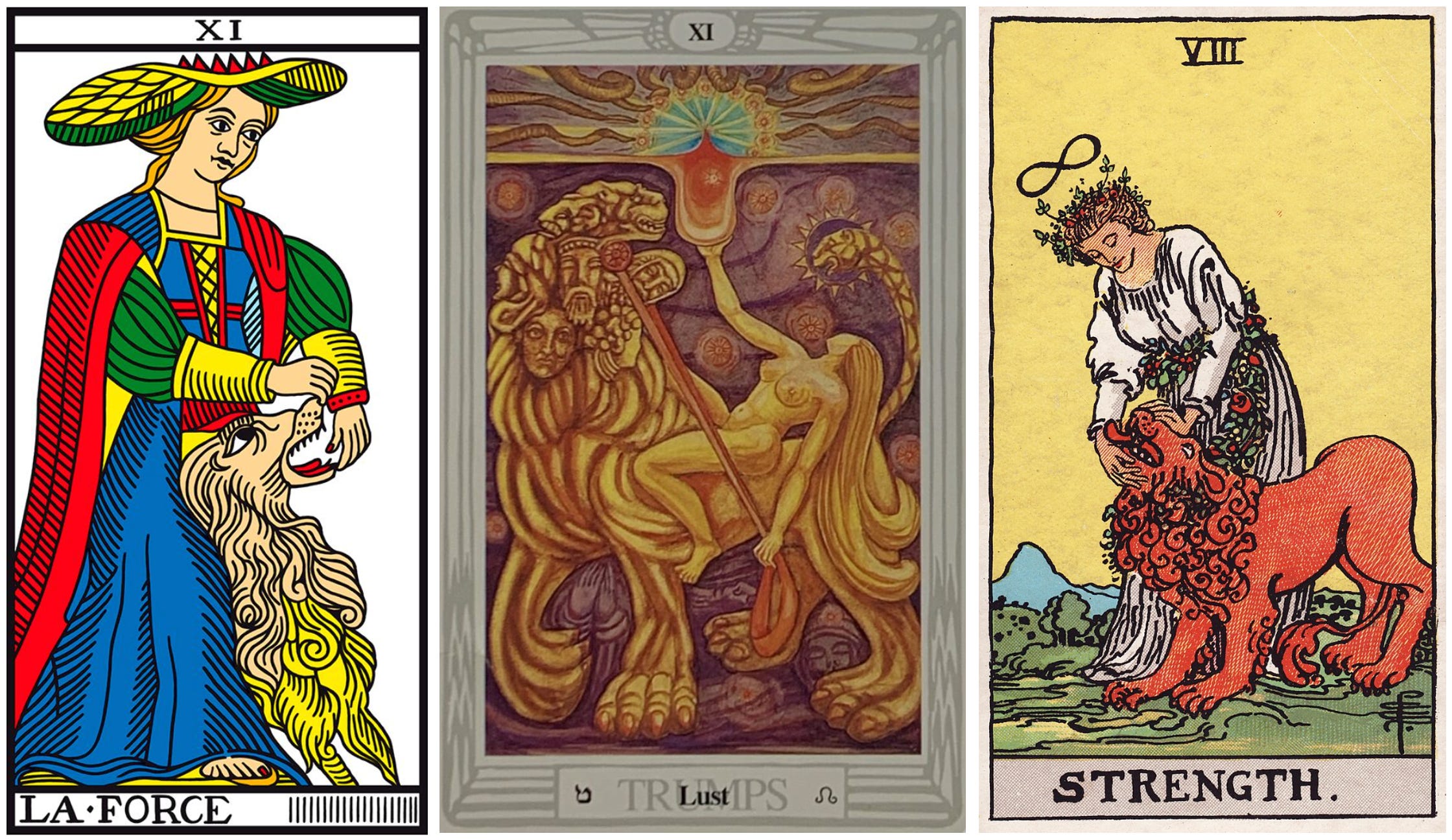
In Seventy-Eight Degrees of Wisdom, Rachel Pollack writes that the change is connected to the secret deck of the Golden Dawn and that “the connection to a secret order suggests the idea of initiation.” As we have discussed before, liminality plays a central role in initiation rituals as the neophyte must be stripped of their previous identity before they can be elevated to their new role. In this sense, Strength is something of a cocoon card, which works out because Liberty is something of a pupa.
Interpretations of Strength vary, but what is clear is that there are two forces at play: woman and beast. That it is a woman portrayed rather than a man suggests this interaction is not one to be won through brute strength, but rather through a redirection of energy, as in martial arts. Woman and beast represent some form of higher and lower, interpretations offer a smorgasbord of specifics— mind and body, heaven and earth, ego and id, love and passion— but most agree that it is not a matter of the higher conquering the lower, which can only lead at best to a stalemate, if not outright repression. Rather, it is the need for the energies to become aligned, for the two to be centrifuged into one, creating a unity that can go further than either alone:
“Strength allows the inner passions to emerge, as the first step in going beyond the ego.”3
Alejandro Jodorowsky is a Marseille purist. As such, he identifies La Force as the first card in the second decimal series (11-20), giving it a special connection to the final card in the series, Judgement. He also points out that it is the only card in the (Marseille) deck to have its name aligned in the left margin, making room for the twenty lines on the right, which give the impression of the title being spring-loaded and ready for launch. Indeed, Strength does represent incredible potential energy, much like a compressed spring:
“Strength holds in potential everything that Judgement will realize, which is to say the emergence of the new consciousness.”
So Liberty is in the cocoon awaiting the emergence of a new consciousness. She is at odds against herself, locked in some silent struggle of which she herself appears only half aware, but it causes her to flit through life, occupying vacant homes much like a ghost. The book’s dialogue reflects this. The majority of which, especially in the first half, takes place between Willie and various strangers as Liberty simply looks on. One even says to Willie, “Your wife looks sad.”
To which he responds, “She’s just one of those wives.”
Willie believes he has Liberty all figured out. He even tells her at one point that he could write her diary. While it is true that Liberty struggles to affect things according to her will, constantly being talked over not only by Willie, but her mother and their friend Charlie who is supposedly in love with her, she is not totally without agency. In each town they go to, Liberty takes it upon herself to care for injured animals and neglected children. In the particular town in which the present day of the novel takes place, it is Teddy and Little Dot who she adopts, and it is through these relationships we learn something of how she got to her current state.
Liberty wasn’t always this way. By all accounts, she was a happy child filled with vitality, but her parents abandoned her when she was still quite young and Willie’s family took her in. While living with them, she became pregnant. When she told Willie, his response was to gather all the pills he could find and have a pharmaceutical picnic.
The overdose does not go according to plan in that they both survive. The baby, however, does not. Liberty wakes up to find herself in a psychiatric hospital where she is held for some time. She is told that she will never again be able to bear children, and then she is unceremoniously released. Or part of her is. The rest remains as if severed, or disappeared.
Only Willie is waiting for her on the other side. He informs her they are not welcome back home, and so begins their life of drifting. They have undergone the first stage in Victor Turner’s three stages of an initiation or rite of passage: Separation, in which “the ritual subject is detached from their previous, fixed position in the social structure.”
Or as Jodorowsky writes of the woman on the card,
“she is not situated in either time or space.”
It is as if Clem is the only thing that keeps Liberty tethered to the earthly realm. One might even say he becomes her body, or at least fills in for her body, keeping her place reserved while waiting for her to return, like any good boy would.

Strength
Simone Weil writes about another kind of force in her famous essay, The Iliad or The Poem of Force. For Weil, force is something like destiny:
“it is that x that turns anybody who is subjected to it into a thing. Exercised to the limit, it turns a man into a thing in the most literal sense: it makes a corpse out of him. Somebody was here, and the next minute there is nobody here at all.”
While Weil is writing primarily about war, Liberty’s suicide attempt might have revealed the same possibility of death that lies locked up in every moment. This clarity of vision strings up the mind, and castrates the soul. One cannot live in such a way. They become locked up, given over to their fate, drained of vitality. Breaking out of this petrifactive constraint requires a rare strength, but “only he who has measured the dominion of force and knows how not to respect it is capable of love and justice.”
This frozen state in which one is given over to force maps quite nicely onto Turner’s second stage, Liminality. Sometimes called the ‘threshold or ‘betwixt and between’, this phase is the central stage of an initiation in which the subject passes through a realm with few of the attributes of the past or coming state. During this ambiguous, transitional period, the standard social structure is temporarily suspended. One leaves structure and enters anti-structure.
While traditional rites of passage follow a pattern that eventually liberate the neophytes from this phase, no such rite is in place for Liberty. In a sense she is trapped in limbo and has been for years. Since it was Willie’s doing that got her stuck in the first place, it is only his disappearance that finally allows her to start the journey towards the final stage, Reaggregation.
About a quarter of the way through the novel, Willie gets up from breakfast and walks out of the diner, never to return, leaving Liberty to spend time in communitas4 with her fellow neophytes. This includes Teddy, one of the children in her care. He has been forced into any number of extracurricular activities by his father’s girlfriend, anything to keep him out of the house. His current enrollment is a sex-education course for which he is assigned to carry around an egg for a week. An egg! What could represent the liminal phase better than that?
Then there is Charlie, Willie and Liberty’s friend, a very successful real estate agent, and an alcoholic who is beginning to feel trapped in the liminal stage of a years-long drunk:
“Where am I calling from? I am calling from home, specifically from Room 303 of the Paradise Hotel on the corner of Coconut and Main. Every time I wake up in this room, I think I’m a case of mistaken identity. Do you see Room 303? The linoleum floor painted red, the single window scraped by palm fronds, the hostile eye of the TV, the ant cakes in the corner, the bureau, the bed, the bottle, me?”
He has pegged all hope of escape on Liberty to whom he repeatedly confesses his love. He has big plans. He is going to stop drinking, they are going to run away together, they will take Teddy, too, but he wants to rename him Reverdy, a French name derived from reverdier, meaning to flourish anew. Which is what they will all do in this dream of his. While on the phone with Liberty, he declares that he will have one last drink and then their new life will begin. This declaration is immediately followed by the sound of breaking glass and a cry, and finally a click as Charlie drops his final drink.
༄༄༄
Though Willie does not return, he does eventually call. The telephone plays a big role in this book: disembodied communication. It seems Liberty is not the only one whose mind/soul has been severed from her body. Williams paints for us a very heady Florida indeed, and maybe one in which are all indicted: a world trapped within the frozen momentum of what has been built around it, possible actors becoming passive neophytes, all of us allowing “intolerable sufferings [to] continue. . . by the force of their own specific gravity.”
Willie asks Liberty to come find him, giving truly psychotic directions:
“Come to me tomorrow. . . Walk to the end of Buttonwood Beach. Go down around six in the morning. That’s when the Gulf is going to be pouring back through the Pass. Jump in, and it will sweep you about a quarter mile down Long Key to a yellow house. I’ll meet you there.”
Despite the distance, Liberty remains under his spell. As Weil writes, once someone has given themselves over to force they will act without sense of self-preservation. Ditto for the neophyte in the midst of a rite of passage or initiation ritual. They have placed their trust in the process. Likewise, Liberty follows Willie’s instructions. She submits herself to the ocean, with Clem following loyally behind. And they are actually delivered, as Willie promised, to a yellow house on Long Key.
Here, Liberty meets a quite literal embodiment of Strength.
Meet Poe, the seventy-five year old body builder who is peaking for her birthday. A truly iconic Williams character. So much of her fiction features drifters encountering the numberless weirdos populating this land, but this scene might be the epitome of that variation:
“Willie came into the room, followed by the old woman. She was tanned and balding. She was oiled up, her hair was short, gray, and grew in tufts. She squatted down and looked upward at them as though to view them better, gazing at them as though they were forlorn, barely sentient creatures in a hutch. Thick, crisscrossing bands of muscle moved in her legs. Her face was gaunt and cruelly scarred, and her breasts were as high and round as a girl’s.”
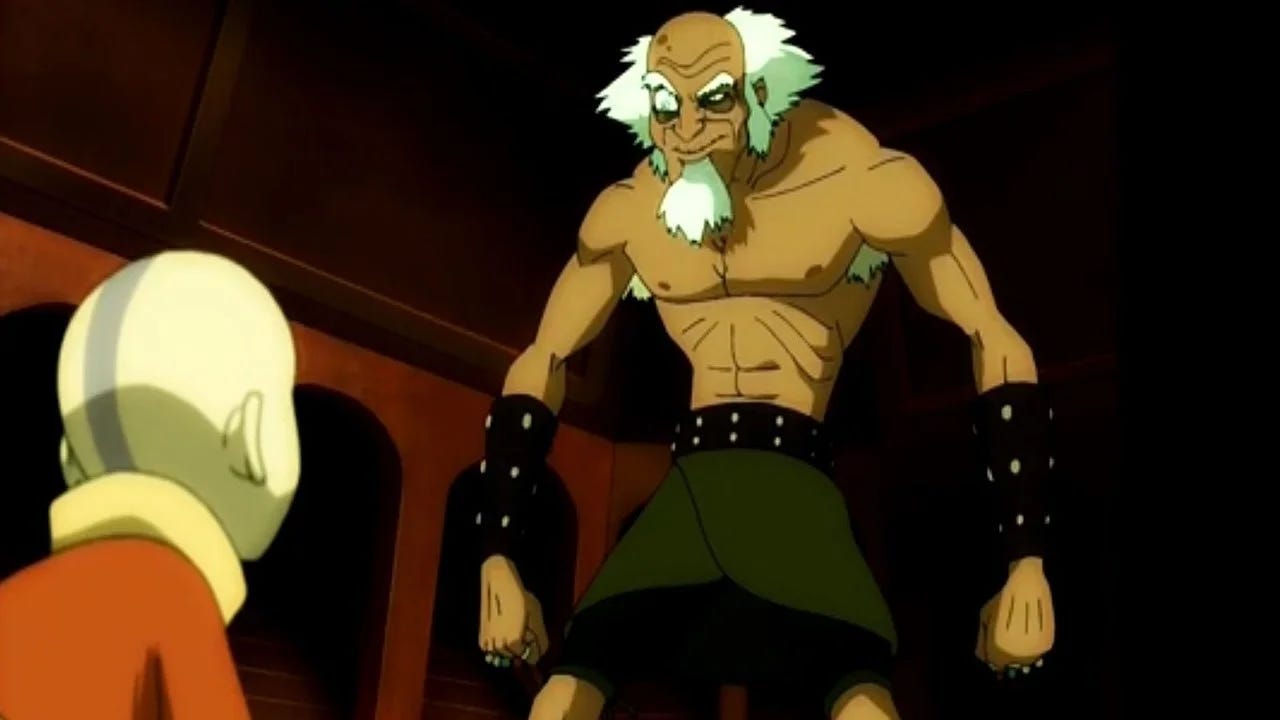
Poe’s own husband spent his life trapped in the mechanics of force. He actually did enter it through war, as Weil writes about. During World War II, his ship was sunk and he spent days floating in the ocean, watching his comrades lose their minds and die one by one.
During this time, Jesus appeared to him.
“He maintained that he was fat, had green eyes and bitten nails and that he was dancing. He danced with my husband. My husband said that he had never known such happiness.”
Her husband never came back from that experience, making Poe an expert in dealing with those trapped within the Liminal. If the Tarot represents a cyclical journey, with each repetition occurring higher up an ascending spiral, then Poe might be a manifestation of Strength from The Next Level. If so, she has surely descended in order to assist Liberty in her own journey, for it is only after meeting her that Liberty admits “she had disappeared long ago, she knew, and so had Willie. But it was time to come back or to vanish.”
While the whole book has a rather dreamy atmosphere, everything that occurs after Poe’s appearance takes on an even more otherworldly feel, as if she really has set things back in motion after a long static period. After eliciting the story of their relationship, Poe offers Liberty and Willie the house, asking them, in return, to kill her, so that she can go out at her peak. This request is shocking enough to make Liberty recoil. Willie, on the other hand, seems more than willing. Perhaps Poe foresaw this split, perhaps not. Either way, it is what finally breaks Liberty free. She exits the house in horror, Clem following behind her, and Poe shouting at her back “You are saved, you are saved.”
Reverdier
Some have speculated that the book post-Poe is occurring in the afterlife. While it does grow increasingly strange, I think it might more fittingly be placed in the archetypal space of the Tarot, or the phase shift of an initiation ritual. The last section marks the culmination of Liberty’s long liminality.
“Willie had gone and entered someone’s life now. He had entered someone’s life because he couldn’t find his own anymore. He would have lived in [Liberty’s] life, she realized, had she not lost hers as well. He had to live somewhere. They had lost their lives beneath the damaged trees years ago. She could still see the dappled light of that morning. It was the way she had seen everything since, stained and scattered.”
But as she emerges from the ocean and back onto dry land, it is like the beginning of the emergence of her new consciousness. Everything old falls away. Willie is gone, left behind with Poe. When she returns home, her mother calls and severs whatever remaining ties, saying she has been reunited with an earlier abandoned child and must focus her energy on her. Then she learns that Teddy’s father has lost it and is giving everything away. He wants to give Teddy to Liberty. Fearing for the child’s safety, Liberty takes action.
Instead of Teddy, she finds Charlie. He is tapering off his chronic drunk with beer at a chaotic party at a bar called The Gator. Through some drunken misunderstandings, he winds up gut stabbed in the parking lot after confronting Teddy’s dad for peeing on his Caddy. They had been about to go looking for Teddy, but instead they must start towards the hospital. Charlie, however, is losing a lot of blood, and isn’t exactly thinking straight. He drives them into a car wash, wanting to get the piss off his car.
In the mayhem, Liberty realizes Clem is not in the car, but it is not because they have been separated. “Dog’s a dream,” as Charlie says. He’d been reserving her a place amongst the living, and now that she is finally willing to reclaim it they have integrated. Liberty’s higher and lower energies align and it is as if she has come back to life. Good boy, indeed.

Despite Charlie potentially bleeding out in the passenger seat, the final image is a beautiful representation of Liberty’s emergence back into the world, as symbolized by her literally taking the wheel as the car she is maneuvering is released from the conveyor track of the car wash it had been passing through, and returns to the freedom of the open road.
[Exit Music]
The book’s epigraph, a quote from Kafka’s “Cross Breeze”, certainly hints at Clem being integral to the “meaning” of the book.
Or Lust if you are using the Thoth deck, but I am not very familiar with this one.
Pollack again.
“Communitas is a Latin noun denoting an unstructured, egalitarian community spirit. Popularized in modern times by anthropologist Victor Turner, it describes the intense social solidarity and deep connection that emerge when people share a transitional experience, such as a rite of passage, freeing them from normal societal structures.” -Wiki
I find it amusing that I was listening to the new Kevin Morby album and paid attention to these words "Where God could be a dog
Barking in the dark
And if it goes pitch black would you come back?" And then read your lovely reflection. Excellent as always. Mount Eerie is one of my personal favorites, have you seen the documentary? https://youtu.be/_LBtwwLFfCU?si=ONSUw3CE9EqA6sJS
I recently read and loved The Changeling, and I'm excited to read this one. Maybe all her protagonists find themselves in sad/creepy situations while wearing bathing suits.